Hand Sewing Needles: How to Identify a Needle by Its Point, Eye and Number
How to identify needles for hand sewing, embroidery and upholstery: what the point, eye and length tell you, how to read numbers like 3/9 and 5/0, and how to match a needle to the thread, the task and the needle threader.
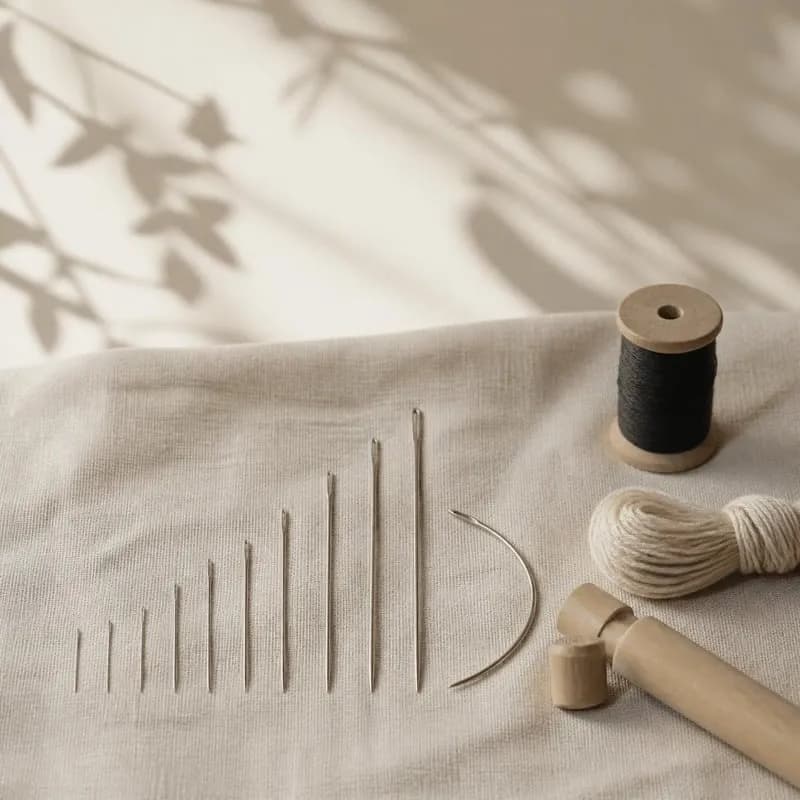
Hand sewing needles are identified by four features: the shape of the point, the shape of the eye, the length and the number. The point tells you what material the needle is meant for, the eye tells you which thread will fit through it, and the length and number tell you how thick it is and what work it is comfortable for. Once you know these four features you can identify almost any needle, even when it is no longer in its packaging, and choose correctly between a regular sewing needle, an embroidery needle, a yarn needle, a doll needle and an upholstery needle. This guide explains how to read the markings, how to tell the types apart, and how to match a needle to the thread and the task.
Four features for identifying hand sewing needles
Point: a sharp point pierces densely woven fabric. A blunt, rounded point passes between the fabric threads without splitting them, and suits open-weave fabric such as Aida. A triangular point, also called a cutting point, is designed for leather and faux leather.
Eye: a small round eye suits regular sewing thread. An elongated eye takes several strands of embroidery floss. A wide eye is designed for yarn. An eye open at the top, with a slot or spring, allows threading without aiming the thread at the hole.
Length: a short needle gives control over small stitches. A long needle is handy for basting and slip stitches, and a very long needle passes through a stuffed body or a mattress.
Number: indicates the needle's thickness within the same type. For hand needles the number works the opposite way from machine needles, and there are several different systems, as explained below.
It is worth looking at the features in this order. The point and eye determine the type of needle, and the number is chosen only once the type is clear.
How to read the number on hand needles
For most hand needles, such as regular sewing needles (sharps) and embroidery needles, the range is roughly 1 to 12, and a higher number means a thinner, shorter needle. In the size chart of a British needle manufacturer, a size 1 sewing needle is about 1.02 mm thick, and a size 12 is about 0.41 mm. In other words, a size 9 needle is much thinner than a size 3.
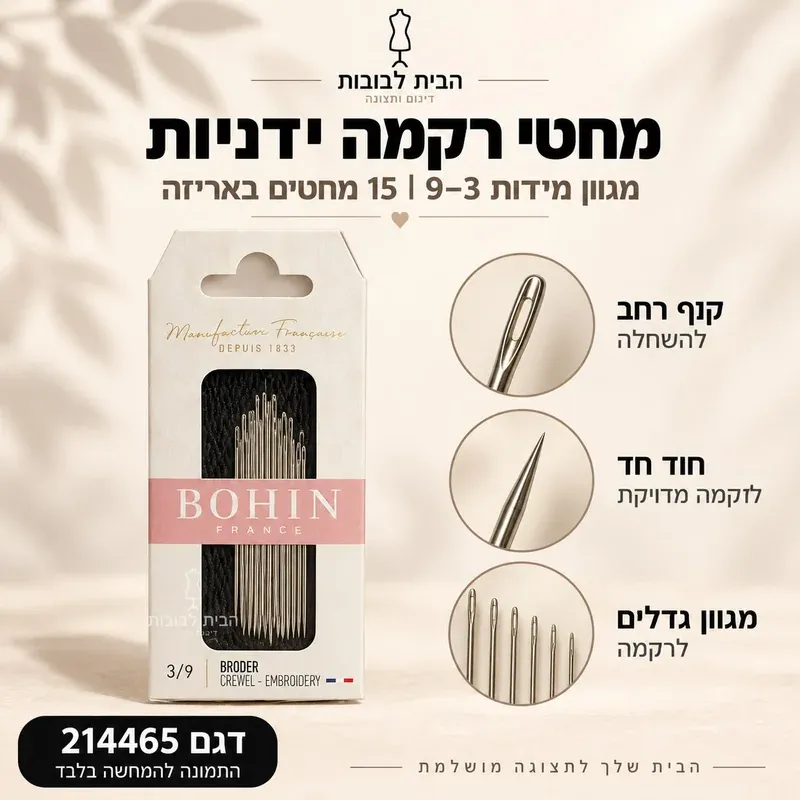
The package usually shows a range rather than a single number. The marking 3/9 or 3-9 means the package contains sizes 3 to 9, from a relatively thick needle to a thin one. For example, BOHIN embroidery needles in sizes 3 to 9 include 15 needles in different thicknesses, and Prym self-threading needles come in sizes 5 to 9.
Numbers with a zero: yarn needles
Yarn needles, known in English as yarn darners, are sometimes marked with a different system: 5/0, 4/0 and so on down to 1/0. Here the logic is reversed, and the more zeros, the thicker the needle. According to the same size chart, a 5/0 needle is about 2.03 mm thick and a 1/0 needle about 1.27 mm. Prym short yarn needles come in sizes 5/0 to 1/0, with a wide eye for thick yarn.
Needles measured by length
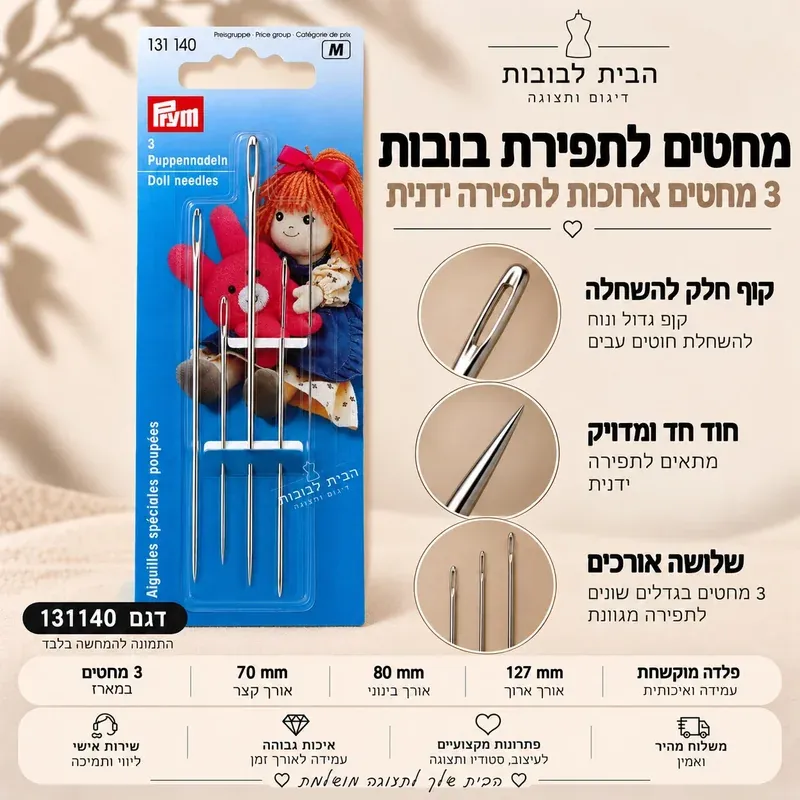
Doll needles and mattress needles are defined by their length, because that is what determines whether they will pass from one side to the other. Prym doll needles come in lengths of 70, 80 and 127 mm, and Prym mattress needles are 250 mm long and 2.35 mm thick. Curved upholstery needles do have numbers, and in the Prym set they are 2, 4 and 5.
Do not compare numbers across types
The number indicates thickness only within the same type. Blunt-point needles for embroidery on Aida (tapestry), for example, are numbered in the range 13 to 28, and a size 7 embroidery needle and a size 7 sewing needle do not have the same eye shape. When you switch type, check the needle against the thread again.
Identification chart: types of needles for sewing, embroidery and upholstery
Regular sewing needle (sharps): sharp point, small round eye, medium length. A general-purpose needle for mending, hems, sewing on buttons and basting.
Short needle (betweens): according to Prym, the same thickness as a regular sewing needle of the same size, but shorter. Handy for slip stitches, multi-layer quilting and delicate hems.
Crewel embroidery needle: sharp point and elongated eye. Similar to a sewing needle in length and thickness, but its eye takes several strands of embroidery floss without fraying them. For free embroidery on linen and cotton, embroidery with fine wool and embroidery on clothing.
Blunt-point needle (tapestry): large eye and rounded point that passes between the fabric threads without piercing them. For cross-stitch, needlepoint and open-weave fabric.
Chenille needle: the same thickness and large eye as a blunt-point needle, but with a sharp point. For thick threads on dense fabrics.
Yarn needle: wide, long eye and a thick shaft. For darning sweaters and socks, joining knitted pieces and weaving in yarn ends. According to Prym it is also suitable for basting and mending heavy workwear.
Self-threading needle: eye open at the top, with a spring or slot. Lay the thread over the opening and press, and it slips into the eye. Prym especially recommends it for people with limited vision or difficulty with fine movements.
Doll needle: straight and very long. Passes through a stuffed body to attach arms and legs or to sculpt facial dimples on a cloth doll.
Curved upholstery needle: semicircular in shape. It goes in and comes out on the same side, so it suits sofas, armchairs and closed seams with no access to the other side.
Mattress needle: straight, long and thick. Passes through the full thickness of a mattress or cushion, for upholstery buttons and tufting stitches.
You can see the embroidery needles together in the embroidery needles category, and the curved needles and mattress needles in the upholstery needles category. A good way to learn identification is a mixed pack, such as the Prym 10-needle pack for handicrafts and embroidery: it contains blunt-point and sharp-point embroidery needles, crewel needles and a small curved upholstery needle. Lay them side by side and compare the points and eyes.
The eye and the thread: a thirty-second test
The basic rule: the thread should go through the eye without being squeezed, and the needle should pass through the fabric without leaving a hole. An eye that is too small frays the thread and makes it catch. An eye that is too large creates a big hole around the stitch and looks sloppy.
Thread the needle with the thread you intend to sew with. If you have to twist or squeeze it to get it in, the eye is too small.
Make a few stitches on a scrap of the same fabric. The needle should glide through without resistance.
If you feel drag or hear a click as the needle passes through, switch to a thinner needle.
If the thread comes apart near the eye after a few stitches, switch to a needle with a longer eye, or a lower number of the same type.
In embroidery, the test goes by the number of strands. With BOHIN needles, a size 7 needle usually suits two or three strands, and when you add strands you move to a larger needle.
Choosing by task
Mending a hem, a button or an unraveled seam: a medium-size regular sewing needle, or a self-threading needle.
Small, even stitches, hand quilting: a short needle (betweens).
Free embroidery on dense fabric: a crewel needle in a size that matches the number of strands.
Cross-stitch on Aida: a blunt-point needle.
A hole in a sweater or joining knitted pieces: a yarn needle with a wide eye.
A stuffed cloth doll: a long doll needle.
A tear in a sofa cover: a curved upholstery needle and strong upholstery thread.
Upholstery buttons in a mattress or headboard: a 25 cm mattress needle.
Our range of mending and craft needles is in the hand sewing needles category.
Needle threaders: which needles they suit
A threader saves you aiming the thread at the eye, but every threader has a needle range. Prym's Needle Fairy, a tabletop threader, suits hand needles 0.5 to 0.9 mm thick according to the manufacturer. Based on the size chart mentioned above, this means very thick or very thin sewing needles may fall outside the range, and yarn needles and mattress needles are clearly thicker than it. Such needles have a large eye anyway, so you can thread them by hand.
Prym's LED threader is small, fits in a sewing kit and lights up the threading area. If you prefer to skip a threader altogether, you can work with self-threading needles, as long as the thread is not too thick for the spring eye. Both threaders are in the needle threaders category.
Common identification mistakes
Confusing a crewel needle with a sewing needle: they are similar in length and point. The difference is the eye: on a crewel needle it is clearly elongated.
A sharp needle on Aida: it splits the fabric threads. For cross-stitch, choose a blunt point.
Comparing numbers across types: a 1/0 yarn needle is thicker than a size 1 sewing needle, despite the same digit.
Mixing needles without packaging: return each needle to its card or package, so its number and type stay known.
If you want to build a basic kit, start with sewing needles in assorted sizes, embroidery needles, yarn needles and a curved needle, and add doll or mattress needles as your work requires. All hand needles are in the hand sewing needles category. For advice and wholesale orders for classes, schools and stores: phone 03-9444226 or WhatsApp 055-2473993.
Frequently asked questions
What does the marking 3/9 on a needle pack mean?
It is the range of sizes in the pack: needles in sizes 3 to 9. For hand needles, a higher number means a finer needle, so such a pack includes relatively thick needles as well as fine ones. A mixed pack is handy if you work with fabrics and threads of different weights.
What does size 5/0 mean on a darning needle?
It is a numbering system in which the zero indicates a thick needle, and the more zeros there are, the thicker the needle. A 5/0 needle is thicker than a 1/0 needle. The system is common for darning needles, which are designed for wool yarn and thick threads.
How do you identify a hand needle that has come out of its pack?
Start with the point: sharp or blunt. Then the eye: small and round on a sewing needle, elongated on an embroidery needle, wide on a wool needle, open at the top on a self-threading needle. Compare the thickness against a needle of known size.
What is the difference between a sharps needle and a betweens needle?
Both have a sharp point and a small eye. According to Prym, a betweens needle has the same thickness as a sharps needle of the same size, but is shorter. The shorter length gives control over small, even stitches, which is why it is popular for quilting and fine hems.
What is the difference between a chenille needle and a blunt-tip needle?
Both have a large eye for thick thread. A chenille needle has a sharp point that pierces dense fabric, while a blunt-tip needle has a rounded point that passes between the threads of an open-weave fabric. Chenille suits embroidery with thick thread on dense fabric, and a blunt tip suits cross-stitch.
Why does the thread fray near the eye of the needle?
Usually the eye is too small for the thread, and the thread rubs against its edges with every stitch. Switch to a needle with a longer eye, such as a crewel needle, or to a lower size of the same type. A needle with a damaged eye can also wear the thread.
Can you sew ordinary repairs with an embroidery needle?
Yes. A crewel needle resembles a sewing needle in length and point, and the main difference is an elongated eye that is easier to thread. On very fine fabric, choose a fine size so the large eye doesn't leave a hole.
When should you replace a hand needle?
When the point feels rough, when the needle has bent, or when you suddenly need more force to push it through the fabric. A needle with a damaged point snags threads in the fabric and leaves large holes.
Is a self-threading needle suitable for thick thread?
It is designed for regular sewing thread. Thread that is too thick opens the spring at the top of the eye and slips out while sewing. For multi-strand embroidery floss or wool yarn, it's better to use a needle with a wide eye.
How do you store needles so you can still identify them?
Return each needle to its original card or package, which lists the type and size. You can also use a felt needle book or a pincushion divided by type. Needles mixed together in one box are hard to identify later.