Glue for Fabric, Leather and Shoes: Which Glue Suits Which Job

How to choose glue for fabric, leather and shoes by task: patches and hems, rhinestones and embellishments, soles and heels, and temporary fixing, with drying times, wash resistance, scrap testing and safety.
Fabric glue should be chosen by the job, not by the name on the tube. Four questions decide it: is the bond permanent or temporary, will the item be washed, which materials are being joined, and how flexible does the bond need to be once it dries. In short: for fabric-to-fabric bonding on washable garments, use textile glue or iron-on bonding powder; for rhinestones and rigid embellishments, use a flexible multi-purpose adhesive such as E6000; for soles and heels, use Shoe Goo or an instant shoe glue; and for holding fabric in place before sewing, use a temporary spray. This guide goes job by job, with the drying times the manufacturers state, and explains how to test glue on a fabric scrap before you touch the garment itself.
Fabric glue: four questions before you choose
Permanent or temporary: does the bond need to last for the life of the item, or only until cutting or sewing is finished?
Washing: will the item go in the washing machine, and at what temperature? A glue that is not stated to be wash-resistant is only suitable for items that are never washed.
Materials: fabric to fabric, fabric to leather, a rigid embellishment to fabric, leather to rubber, or foam to wood. Each combination calls for a different glue.
Flexibility: garments and soles bend constantly. A glue that hardens into a rigid layer can crack with movement, so for fabric and shoes choose a glue that stays flexible after drying.
Which glue for which job
Patches, hems or appliqués on washable garments
Textile glue: Gütermann HT2 textile glue is designed for bonding fabric to fabric, as well as fabric to leather, faux leather and PVC. Spread a thin layer on one side, wait about 5 minutes, press together and leave for about 30 minutes before moving the garment. The bond stays flexible and is washable up to 40°C, and going over it with an iron after drying strengthens the bond.
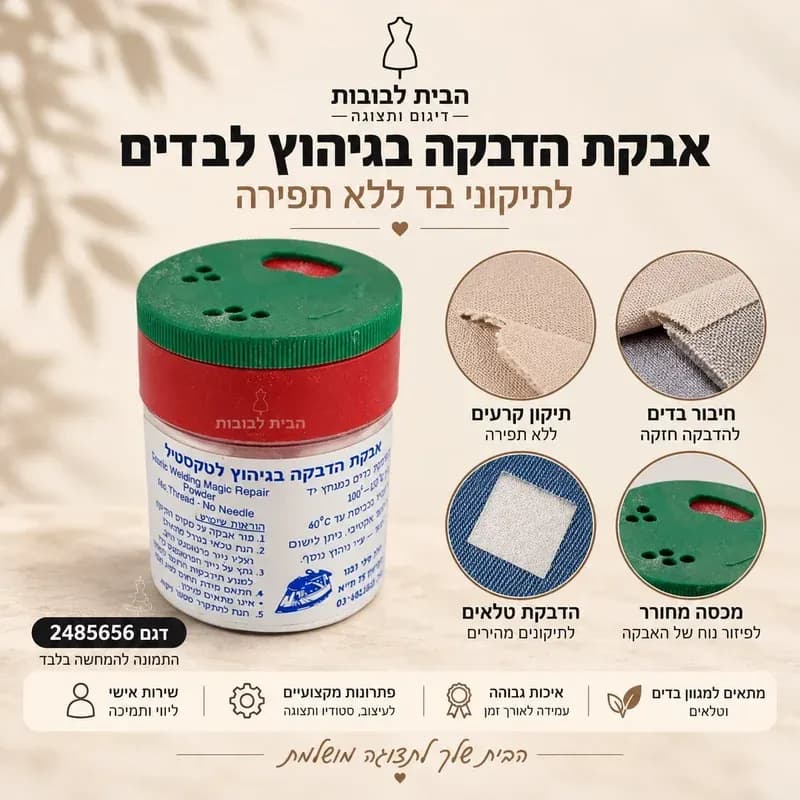
Iron-on bonding powder: when you want to mend a tear or attach a patch without liquid glue, iron-on bonding powder melts under the heat of the iron and joins the two layers. Sprinkle a thin layer, cover with baking paper, press the iron down rather than sliding it, and let it cool completely. The repair is washable up to 40°C. The powder is not suitable for nylon or for fabrics that cannot withstand ironing heat.
Stones, rhinestones and rigid embellishments on fabric and leather
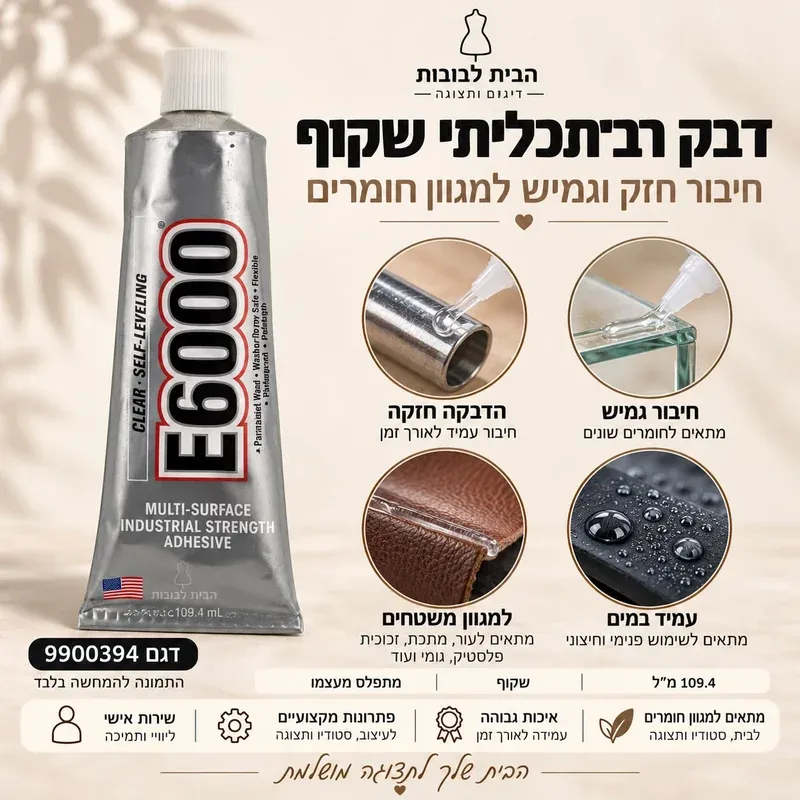
Flexible multi-purpose adhesive: a rigid embellishment needs a thick glue that fills the gap between its back and the fabric. E6000 dries clear and stays flexible like rubber, bonds leather, vinyl, fabric, metal and glass, and according to the manufacturer is resistant to machine washing and drying. For spot repairs or a few stones, the 5.3 ml E6000 tube is a good fit, and for ongoing work on evening gowns and costumes, the 109.4 ml E6000 tube, a self-levelling formula that spreads into a smooth layer. The glue does not stick to polyethylene, polypropylene or polystyrene foam.
Leather and faux leather
When joining fabric to leather, for example a lining to a strap or a leather patch onto fabric, textile glue is the right choice. When joining leather to a rigid item such as a buckle, rivet or metal embellishment, E6000 is the right choice. For bonding leather or faux leather over a large area, such as the base of a bag, use a permanent spray adhesive that sprays a fine mist: spray both surfaces from a distance of 15–20 cm, wait about a minute and press together firmly.
Shoes: a sole that has come loose, a worn heel, a strap
Shoe Goo: Shoe Goo is thick and elastic, so it both bonds and fills. Suitable for leather, rubber, vinyl and canvas. Apply to both surfaces, wait about 2 minutes and press together firmly. According to the manufacturer it is waterproof as soon as it is applied, and to rebuild a worn edge you apply thin layers and let each layer set for 3–4 hours.
Instant shoe glue: for a small spot repair, such as a lifted sole edge or a leather strap, a dedicated instant shoe glue is the right choice. It hardens within seconds and forms a thin, rigid layer, so it is not suitable for rebuilding a worn sole. One or two drops are enough; a large amount weakens the bond.
Temporary hold before cutting and sewing
Temporary spray: holds fabric, pattern paper or a stencil in place and lets you lift and reposition. Spray a thin layer from about 30 cm onto the wrong side of the fabric or onto the paper. It is not intended for bonding a finished product.
Adhesive tapes: double-sided body and clothing tape secures a neckline, a strap or a temporary hem. On silk and velvet, test first in a hidden area and remove slowly. For joining paper pattern pieces, matte tesa film Invisible tape is a good choice: you can write the measurement on it and it does not show in photos or scans.
Upholstery, foam and displays
For foam and absorbent materials, use a web-pattern spray adhesive whose strands stay on the surface rather than soaking into the material: spray both sides from about 30 cm and wait about 20 seconds. For building displays, sets and craft projects from fabric, felt, cardboard and wood, a 40W hot glue gun is a good fit; it takes 11–12 mm glue sticks, sold separately. For an item that will be washed, choose a glue whose manufacturer states it is wash-resistant.
Drying times: when to touch, when to wear and when to wash
There are three stages worth distinguishing: the time until the glue turns tacky and you can press the parts together, the time until the item can be moved, and the time until full strength. The first wash or wear comes only after the third stage.
Gütermann HT2: about 5 minutes waiting before pressing together, about 30 minutes drying before moving.
E6000: according to the manufacturer, turns tacky after about 2 minutes and begins to set after about 10 minutes. A thin layer dries within 24 hours, and a thick layer needs 48–72 hours to reach full strength.
Shoe Goo: tacky after 2–3 minutes, 24 hours before wearing, and 48–72 hours to full strength in a thick layer.
Bonding powder: ready once the fabric has cooled completely after ironing.
The manufacturer of E6000 and Shoe Goo notes that temperature and humidity change the drying time: in cold and high humidity, drying takes longer. The recommended application range for E6000 is 10–32°C. You can speed things up with a hair dryer on low heat, without aiming the heat directly at the glue.
Test on a fabric scrap before you start
Cut a scrap of the same fabric, or choose a hidden area of the garment, such as the inside of the hem.
Apply exactly the amount and the application method you plan to use on the real job.
Wait the glue's full drying time, not just until it looks dry.
Check the right side: staining, bleed-through, a change of shade or shine.
Bend and stretch the fabric and check that the glued area has not stiffened or cracked.
If the garment will be washed, wash the scrap at the temperature you will actually use, and no higher than the temperature the manufacturer states.
Ventilation and safety
E6000 and Shoe Goo contain solvents. Work in a ventilated space and avoid breathing the fumes. E6000 is not intended for items that come into contact with food or drinking water.
Use spray adhesives away from flames and heat, and cover the work area with paper.
Instant glue bonds skin within seconds. If glue gets on your fingers, soak them in warm soapy water and separate them gently.
Do not touch the nozzle of a hot glue gun or the glue itself, rest the gun on a heat-resistant surface and never leave it plugged in unattended.
Clean E6000 and Shoe Goo with acetone while still wet; once dry, only by scraping or cutting. On fabric, test the acetone first in a hidden area.
Adhesives for everyday work in the studio and the shop
An evening-wear studio, a costume department or a shop that does alterations for customers usually needs three types within reach: textile glue for fabric repairs, a multi-purpose adhesive for embellishments, and a temporary spray for the cutting stage. Wholesale quotes are given by quantity, by phone or on WhatsApp.
All the adhesives, sprays and adhesive tapes are gathered in the Adhesives category. If you are not sure which glue suits a particular fabric or material, contact us with the details of the job and we will help you choose.
Frequently asked questions
What is the difference between E6000 and Shoe Goo?
Both are flexible, waterproof adhesives from the same manufacturer, but for different uses. E6000 is a multi-purpose adhesive suitable for bonding stones, leather, fabric, metal and glass, and once cured it withstands temperatures from minus 40°C to 82°C. Shoe Goo is thicker, designed for repairing shoes and rebuilding worn soles and heels, and withstands up to 66°C.
Can I use super glue on fabric?
Super glue cures into a thin, rigid layer, so it is poorly suited to fabric that bends and stretches with the body. For garments, choose a textile glue that stays flexible after drying. Super glue works for small repairs on stiffer materials such as buckles, leather straps and rubber.
How long should I wait before wearing a shoe repaired with Shoe Goo?
At least 24 hours. When the repair is thick, for example when rebuilding a heel, full strength is reached only after 48–72 hours. In cold and high humidity, drying time is longer.
How do you rebuild a worn sole edge or heel?
Clean and lightly roughen the area, and apply Shoe Goo in thin layers rather than one thick layer. According to the manufacturer, let each layer set for 3–4 hours before the next one. When finished, leave the shoe to cure for at least 24 hours.
Is a hot glue gun suitable for gluing on clothes?
A hot glue gun is intended mainly for crafts, displays and props, on fabric, felt, cardboard and wood. For a garment that will be washed, choose a glue whose manufacturer states wash resistance, such as textile glue or E6000. With any new material, test first on a small scrap.
Is clear E6000 suitable for items in a shop window facing the sun?
According to the manufacturer, clear E6000 was not formulated for sunlight exposure. For maximum UV resistance you can paint over it after it has fully cured. Keep this in mind for a display that stands in direct sunlight.
Is iron-on fusing powder suitable for synthetic fabrics?
The powder suits fabrics that can withstand ironing heat, such as cotton, linen and denim, and it is not suitable for nylon. On other synthetic fabrics, test first on a scrap at a temperature the fabric can handle. Always iron through baking paper.
How do you hold pattern paper on fabric without pins?
Spray a thin layer of temporary spray adhesive on the back of the pattern paper from about 30 cm, and lay it on the fabric. You can lift and reposition it until cutting is finished. On fine or light-colored fabric, test first on a scrap.
How do you use double-sided clothing tape correctly?
Apply it to clean, dry skin with no lotion, oil or perfume, and cut several short strips instead of one long one. On delicate fabrics such as silk and velvet, test first on a hidden area. Peel it off slowly and parallel to the skin, and never reuse the same strip.
At what room temperature should you work with E6000?
The manufacturer recommends applying the adhesive at 10–32°C. In cold and high humidity, curing takes longer, and you can speed it up with a hair dryer on low heat without pointing the heat directly at the adhesive. Once fully cured, the adhesive withstands temperatures from minus 40°C to 82°C.