How to Dress a Display Mannequin: Step by Step, Even Without Arms

A practical guide to dressing a display mannequin by type: armless torso, fixed arms, detachable arms and lower bodies, with fitting oversized garments without pins in the mannequin's body and a check before setting it up.
How you dress a display mannequin depends first of all on the type of mannequin: a torso without arms is dressed from the top through the neck, a mannequin with fixed arms is dressed with the garment fully open, one sleeve at a time, and a mannequin with detachable arms is dressed after removing the arms and passing them back through the sleeves. Lower bodies without legs are dressed from the bottom up. This guide goes through each type step by step, explains how to fit an oversized garment without sticking pins into the mannequin's body, and what to check before the mannequin goes back into the window or onto the photo set. It is intended for clothing store staff, window dressers and product photographers for online stores.
Before you start: preparing the garment and the mannequin
Most dressing problems start before the garment even touches the mannequin. A few minutes of preparation saves pulling, stretching and marks on the fabric.
Iron or steam the garment beforehand. A crease that goes onto the mannequin stays in the window, and a dressed mannequin is hard to iron.
Move the price tag. A tag hanging from the sleeve or collar stands out in the display. Attach it to an inside seam or the back label so it doesn't get lost and isn't visible.
Dust the mannequin. A soft, slightly damp cloth is enough for most finishes.
Work in a tidy space. It's easier to dress in the back room or on a table than in the middle of the sales floor. A heavy mannequin can be laid on a table, or ask a colleague to hold it.
Check the size. Compare the garment's chest circumference with the mannequin's chest circumference. A garment that is too tight will stretch and gape at the buttons; a very loose one will create folds that need to be gathered at the back.
Set the height before dressing. On a mannequin with an adjustable pole, set the height before dressing, because the weight of the garment makes adjusting harder afterwards. Make sure the locking knob is fully tightened.
How to dress a display mannequin without arms
The women's display mannequins in the catalog have no arms, for example the female full-body display mannequin to the thighs, which starts at the neck and ends at mid-thigh. On a mannequin like this, every top goes on over the neck and shoulders.
Button-down shirt and open jacket
Undo all the buttons or the zipper, place the garment over the shoulders from behind and bring it forward. Straighten the shoulder line, and only then fasten the buttons from top to bottom. An open jacket over a shirt is a simple way to show a complete look on a torso.
T-shirt, sweater and tank top
Roll the garment up from the hem to the neck opening, pass the opening over the mannequin's neck and unroll the garment downward. This way the collar doesn't stretch and the seams aren't pulled to the side.
Dresses and fitted garments
It's worth gently stretching a very fitted garment by hand before dressing, so it doesn't drag over the shoulders and lose its shape. Open a dress with a zipper all the way. Also check the length: a torso that ends at mid-thigh displays garments that end at that point well. Long trousers, maxi dresses and knee-length skirts will hang unsupported below the thigh and look limp. On the female mannequin mentioned above, sizes 36 to 38 look natural; from size 42 up the garment looks loose, and size 34 looks stretched.
Mannequin with fixed arms
On the men's torso with arms the arms hang down along the body, and the garment has to go around them. The correct order:
Open the garment completely, including all buttons and the zipper.
Slide one sleeve over the hand and pull it up to the shoulder.
Bring the garment around behind the back and put on the second sleeve.
Straighten the shoulders and collar, and only fasten at the end.
A fitted garment with no front opening, such as a sweater, goes over the neck first after gently stretching the neck opening, and then the arms go into the sleeves. For shirts, jackets and coats, the arms give the sleeves volume and natural folds. For T-shirts and polos a torso without arms is more convenient.
Mannequin with detachable or jointed arms
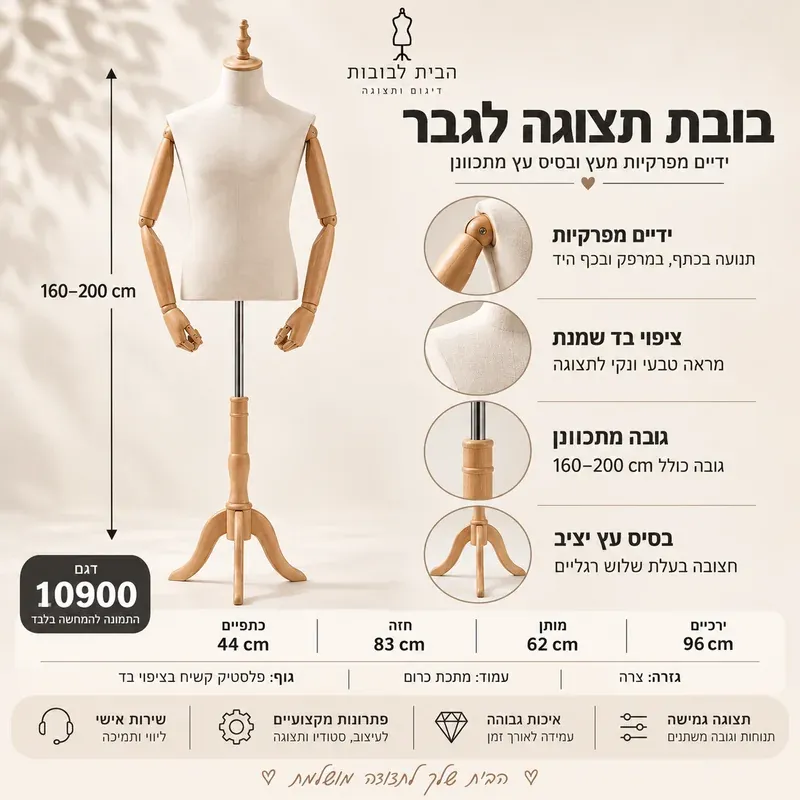
On mannequins with detachable arms, first remove the arms, dress the body, and put each arm back through its sleeve. The men's display mannequin with jointed wooden arms has three points of movement, at the shoulder, elbow and wrist, and the arms come off the body.
Remove the arms, or bend them forward if the garment is wide enough.
Place the garment over the shoulders.
Insert one arm into a sleeve, hand first, and attach it to the shoulder. Then the second.
Before securing the arm to the body, check that no fabric is caught in the joint.
Only at the end, set the shoulder, elbow and hand into the final pose.
When a joint feels stuck, loosen the fabric around it a little rather than forcing the bend. On mannequins where the hand is separate from the arm, remove it at the connection line at the wrist and put it back once the sleeve is in place. Arms from different mannequins usually don't fit each other, so it's best not to mix parts between mannequins.
Lower bodies: hips, lower torso and mannequins with legs
Hips and lower torso without legs: roll up the underwear or shorts, slide them on from below through the thigh cutouts and pull up to the waist. Center the waistband so the logo is straight. In a group of several mannequins you can turn one halfway around to show the back.
Bodysuits and one-piece swimsuits on a mannequin on a pole: release the body from the pole and dress it from the hips upward, then put the mannequin back on the pole and tighten the lock.
Mannequin with detachable legs: separate the legs from the body, turn them upside down, put on tights or socks first if needed, and then the trousers. Reattach the legs to the body, stand the mannequin on its base and straighten the trousers. When the legs are joined together in a wide stance, you can remove one leg, slide it into the trousers and reattach it. Choose shoes one size larger than the mannequin's foot, and put them on while a colleague lifts the mannequin slightly.
Fitting without pins in the mannequin's body
Fiberglass and hard plastic display mannequins are not designed for pins to be stuck into them. Fit a loose garment at the back, on the side the customer doesn't see: gather the excess fabric along the center line of the back and secure it with a display clip or safety pins that close on the fabric itself only. Check that the pin doesn't leave a hole in delicate fabric. This way the front looks smooth and clean.
Don't hang a heavy item, such as a bag or coat, on one shoulder. Spread the weight or place heavy accessories near the base.
Dark garments with unstable dye can stain a skin-tone mannequin during a long display.
The neck of an upper torso is suitable for necklaces and light scarves. Display bags separately.
Final check before the mannequin goes back into the window
Look at the mannequin from every direction, and especially from the angle at which the customer will see it from the street or the aisle.
Check that tags, clips and pins are hidden.
Move a dressed mannequin by holding the pole or the base, not the shoulders.
In product photography, keep the same arm position and the same height for every garment so the images in the store are consistent. A light, simple background helps the garment stand out.
How to position several mannequins together, at what height and with what lighting, is covered in the guide Window display design for a clothing store.
Which mannequin is easiest to dress
Torso without arms: quick to dress and change, with no dismantling and no sleeve order. Suitable for tops, swimwear, short shirts and short dresses.
Torso with fixed arms: requires the right working order, but no dismantling. Suitable for shirts, jackets and coats.
Mannequin with detachable or jointed arms: takes more time, and lets you choose a pose and dress even fitted garments with sleeves.
You can see all types, with full measurements for every model, in the Display mannequins category, and separately in women's display mannequins and men's display mannequins. For questions about which mannequin suits your clothes, or for a bulk order for a store or chain, contact us by phone at 03-9444226 or on WhatsApp at 055-2473993, or visit the showroom at Kfar Giladi 15, Tel Aviv.
Frequently asked questions
How do you put a long sleeve on a display mannequin with fixed arms?
Open the garment completely, slide one sleeve over the hand and pull it up to the shoulder. Then bring the garment around behind the back and put on the second sleeve. Only once the shoulders are in place, close the buttons or the zipper.
How do you dress a sweater with no opening on a torso with arms?
Gently stretch the neck opening and pass the sweater over the mannequin's neck. Then guide each arm into its sleeve and pull the sweater down. If the sweater is very tight, a torso without arms or a mannequin with removable arms is a better choice.
How do I dress underwear or swimwear on a display hip form?
Roll up the garment, slide it on from below through the leg openings and pull it up to the waist. Then center the waistband so the logo or print sits straight. A garment that is too small will stretch over the form and distort the print.
How do I dress a bodysuit on a mannequin mounted on a pole?
Release the mannequin's body from the pole and put the bodysuit on from the hips upward. Once the garment is in place, put the mannequin back on the pole and make sure the locking handle is fully tightened. This way you don't have to stretch the garment over the shoulders.
Why should you adjust the pole height before dressing the mannequin?
The weight of the garment, especially a jacket or coat, makes the adjustment mechanism harder to operate once the mannequin is dressed. Adjusting before dressing also prevents the garment from being pulled while raising or lowering. After adjusting, check that the lock is tight.
How do I move a dressed mannequin without distorting the garment?
Hold the mannequin by the pole or the base, not by the shoulders. Gripping the shoulders pulls the garment, changes the shoulder line and can shift the clips at the back. After moving it, look over the mannequin again from every angle.
Can you dress long trousers on a torso that ends at the thigh?
Not advisable. A torso that ends mid-thigh doesn't support the fabric below the thigh, so long trousers will hang limply. Display long trousers on a mannequin with legs, a lower-body form with full legs, or a hanger.
How do I dress trousers on a mannequin with removable legs?
Detach the legs from the body, turn them upside down and pull the trousers onto them. Then attach the legs to the body, stand the mannequin on its base and straighten the trousers. If the legs are in a wide stance, you can remove one leg, slip it into the trousers and reattach it.
What do you do when a wooden arm joint gets stuck inside a sleeve?
Ease the fabric around the joint a little and don't force the bend, because forcing it damages the joint and stretches the garment. It's easier to put the arm into the sleeve while it's detached or bent forward, and set the final pose only at the end.
Can arms be swapped between different display mannequins?
Usually not. The attachment mechanism and the dimensions of the arms vary from mannequin to mannequin, and an arm that doesn't belong to the mannequin may not lock or may sit crooked. Keep each pair of arms with its own mannequin, especially when you take several mannequins apart at once.