Thread Snipper or Embroidery Scissors: Which Suits Which Job

When to use a thread snipper, when straight or curved embroidery scissors, and when appliqué scissors: cutting at the sewing machine and overlocker, Hardanger, machine embroidery and appliqué.
A thread snipper is the right tool for quickly cutting thread ends while you work, next to the sewing machine and the overlocker, with the fabric still in your hand. Embroidery scissors are for precise cutting close to the fabric: a straight, fine blade for Hardanger and counted-thread embroidery, and a curved blade for clearing threads above the fabric surface and on the back of the embroidery. Appliqué scissors, with a wide lower blade, are designed for trimming the top layer of fabric close to the stitching without damaging the layer underneath. The choice depends on what you are cutting, how many times a day, and how close to the fabric you need to get, not on the size of the tool alone.
Three tools, three different jobs
On the shelf the three tools look alike, all small and sharp, but each is built for a different action. Anyone who uses one tool for every task usually finds it slow in one place and risky for the fabric in another.
Thread snipper: two short blades joined by a spring body, with no finger rings. Squeeze both sides and the blades close on the thread; release and they spring open on their own. The advantage is speed and one-handed work, without putting down the fabric or the hoop.
Embroidery scissors: small scissors with finger rings and a very fine tip. Overall length of about 9 cm and a cutting length of about 2 cm in the classic models. The rings give precise control of the tip, so they suit work where you cut one thread out of several lying close together.
Appliqué scissors (duckbill scissors): a narrow, sharp upper blade and a wide, rounded lower blade that lies flat on the fabric. The wide blade separates the layer being trimmed from the layer that stays, so you can cut very close to the stitching without cutting the base fabric.
When a thread snipper is the right tool
A thread snipper is the tool for continuous work: the end of every machine seam, the overlocker's thread chain, clearing threads from a finished garment before pressing and packing. When you cut dozens or hundreds of times a day, the difference between picking up scissors and slipping your fingers into the rings and a single squeeze of the palm shows in your pace and in hand fatigue.
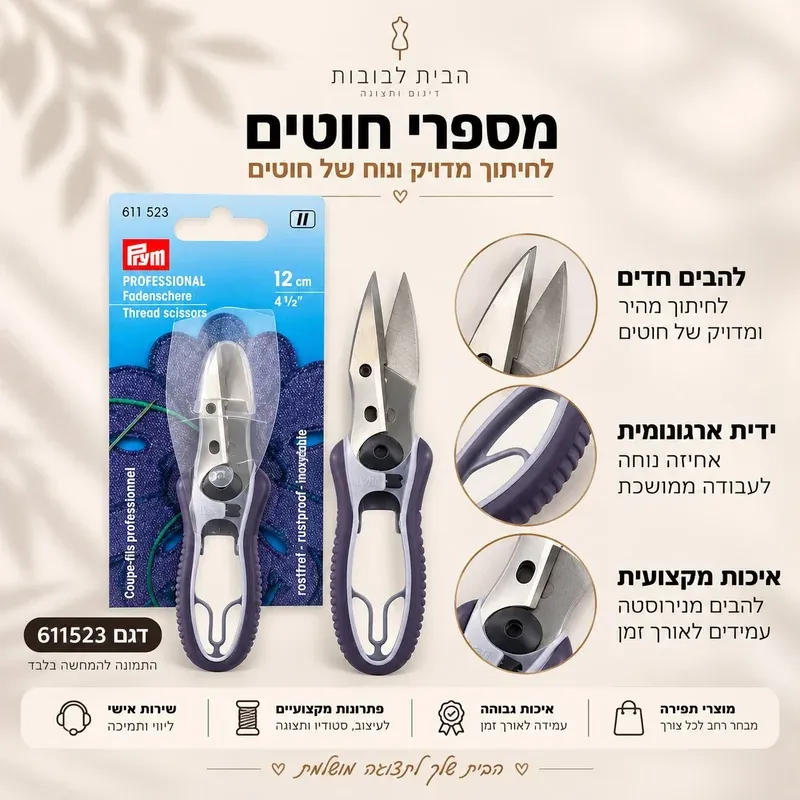
There are two main types. The PRYM Professional thread scissors, 12 cm long, work on the same squeeze-and-release principle, with stainless steel blades, an ergonomic two-material handle, hard and soft, and a cover that closes over the tip. They are especially suited to long working sessions, a studio and a production line. One-piece spring-steel snippers, such as the thread snipper with pointed blades and a red sheath, are light and easy to keep next to every machine, and their sharp point slips under a single thread.
What a thread snipper doesn't do: it isn't meant for fabric, ribbons, paper or thick materials, which can bend the blades and knock them out of alignment. According to the PRYM product page, metallic thread and thick nylon also dull the blades. Nor does it replace a seam ripper, because using the tip as a lever bends it.
Embroidery scissors: straight blade or curved blade
The difference between a straight and a curved blade is not a matter of taste. It determines how the tool meets the fabric.
Straight, fine blade: Hardanger and counted-thread embroidery
The DMC HARDANGER embroidery scissors are an example of this tool: 9 cm overall, with straight, fine, sharp stainless steel blades 2 cm long. DMC describes them as an essential tool for the Hardanger technique, in which threads are cut out of the fabric itself to create the openings in the pattern. A straight blade lets you slide the tip under a single fabric thread and cut in a straight line right against the stitch block. It is also suitable for cross-stitch, cutting embroidery floss and tidying ends on the back of the work.
Curved blade: cutting close to the fabric surface
The Kretzer SPIRALE Classic embroidery scissors have a curved blade of forged carbon steel with a nickel and chrome finish, 9 cm overall, made in Solingen. The curve lifts the tip above the fabric, so you can lay the scissors flat and cut a thread close to the surface without poking the tip into the fabric. This is the tool for clearing jump stitches in machine embroidery, tidying the back of the embroidery and fine trimming around appliqué. The Classic-Cut model from the same series has identical dimensions, 9 cm with a 2 cm cutting length, with a fine tip and a curved blade.
Small scissors with a longer blade
When you need to both cut threads and reach into corners and notches in the seam allowance, a 2 cm blade is too short. The D.PERES SOLINGEN small scissors, 11.5 cm long with a 5.5 cm blade, are used for cutting thread at the end of a seam right against the fabric, for corners and notches, for opening short seams and for cutting small pieces of fabric. Traditional stork scissors, with fine pointed blades and decorative handles, suit hand embroidery and cross-stitch at the hoop.
Hardanger embroidery: how to cut without damaging the blocks
In Hardanger, any thread cut by mistake is very hard to repair, so the order of work matters more than the tool itself. The steps, according to the DMC HARDANGER product page and professional Hardanger guides:
Work on evenweave fabric. First complete the satin-stitch blocks around the area to be cut.
Count and mark the threads before cutting, and check again.
Cut only on the side of the block where the stitches enter the fabric. Never cut on the side parallel to the stitches.
Slide the tip of the scissors under the thread and make sure only the thread you need to cut is caught.
Cut right against the block so no ends stick out, then pull out the cut threads to open the hole.
Work in good light, especially on dense fabric.
Large or dull scissors are not suitable for this stage, because they don't give the control the tip requires.
Appliqué scissors: the wide blade that protects the bottom layer
The PRYM appliqué scissors are 15 cm long, made of steel, with a wide, rounded lower blade and a narrow upper blade. They are designed for trimming excess fabric in hand and machine appliqué, for reverse appliqué where the top layer is opened to reveal the fabric underneath, for trimming fabric inside an embroidery hoop between stitching stages, for cleaning up edges in quilting and patchwork, and for grading seam allowances.
How to use them: slide the wide blade between the layer you are trimming and the base fabric, guide it along the stitching and cut with short strokes. Gently pull the excess fabric away from the stitching to get closer. The wide blade doesn't cut, so it protects the base fabric and the stitches.
Limitations: the blade is short and meant for trimming excess, not for cutting whole garment pieces or thick layers. In most cases the tool is built for the right hand, and left-handed duckbill scissors are a separate model that you have to look for specifically.
Which tool for which job
At the sewing machine: a thread snipper, to cut at the end of every seam without putting the fabric down.
At the overlocker: a separate thread snipper that always stays by the machine. For continuous work, a model with an ergonomic handle is best.
Hand embroidery and cross-stitch: embroidery scissors with a straight blade and a fine tip, or stork scissors.
Hardanger and cutwork: straight, fine, extra-sharp embroidery scissors.
Machine embroidery: curved embroidery scissors for jump stitches above the fabric, and a thread snipper when you hold the hoop in one hand.
Appliqué, quilting and patchwork: appliqué scissors, plus curved embroidery scissors for fine cutting around edges.
Finishing garments and production lines: a thread snipper with a handle that is comfortable for long use.
Threads, corners and small repairs: small scissors about 11.5 cm long, with a longer blade than embroidery scissors.
Protective covers and caring for the tip
In all three tools the tip is the most important and most vulnerable part. A fall onto the tip can bend it, and working on paper, plastic or thick fabric dulls it. The cover that closes over the tip of the PRYM scissors and the thread snipper's sheath protect both the tip and your hand when you reach into a notions box or bag. Store embroidery scissors and stork scissors in a sheath or box, and wipe and dry carbon steel scissors after use. An occasional drop of oil on the pivot keeps them closing smoothly.
A simple rule that saves replacements: a thread tool cuts only thread. Use fabric shears for fabric, and separate scissors for paper.
All the snippers and small scissors mentioned here are in the thread snippers and thread scissors and embroidery scissors and small scissors categories, for private purchase and for bulk orders for a studio, fashion school or store. For questions about matching a tool to a specific job, or for a wholesale quote, call 03-9444226 or message us on WhatsApp at 055-2473993.
Frequently asked questions
What is the difference between appliqué scissors and curved embroidery scissors?
On appliqué scissors the lower blade is wide and rounded and lies flat on the fabric, to separate the layer being cut from the layer that stays. On curved embroidery scissors both blades are slim, and the curve lifts the point above the fabric to cut threads close to the surface. Appliqué scissors are used for trimming excess fabric, while curved embroidery scissors are used mainly for threads and fine cutting around edges.
Which side does the wide blade of appliqué scissors go on?
Slide the wide blade between the layer you want to trim and the base fabric underneath it. The narrow, sharp blade stays above the layer being cut, and you guide the scissors along the stitching in short strokes. Gently pulling the excess fabric away from the seam helps you trim closer.
Are there left-handed appliqué scissors?
Yes, but it is a separate model. Standard duckbill scissors are in most cases built for the right hand, and the asymmetrical blade design doesn't allow comfortable use in the other hand. Left-handers need to look for a model made specifically for left-handed use.
Where do you cut the fabric threads in Hardanger embroidery?
Cut only on the side of the block where the stitches enter the fabric, never on the side parallel to the stitches, as Hardanger guides instruct. Slide the point under the thread, make sure only the right thread is caught, and cut close to the block. Count the threads twice before every cut, because a thread cut by mistake is hard to fix.
Can I trim the appliqué fabric while the work is still in the embroidery hoop?
Yes, and appliqué scissors are made exactly for this. After the placement and tack-down stitches, slide the wide blade under the excess fabric and trim close to the stitching without taking the work out of the hoop. That way the finishing stitch covers the cut edge exactly in place.
Which small cutting tools does a beginner sewist need?
For most work, a thread snip by the machine and a pair of embroidery scissors or small scissors for precise cutting close to the fabric are enough. Appliqué scissors are worth adding only if you work with appliqué, patches or quilting. For cutting fabric, you also need separate fabric shears.
What is the difference between the Kretzer SPIRALE Classic and the Classic-Cut?
Both models have identical dimensions: 9 cm overall length, 2 cm cutting length, a curved blade and forged carbon steel from Solingen. The Classic is described with a nickel-chrome plating and comes in grey packaging, while the Classic-Cut comes in red packaging and is described as having a fine point for cutting threads close to the fabric. Both are intended for threads and embroidery, not for thick fabric.
Can I cut metallic thread or thick nylon thread with thread snips?
Not recommended. According to the manufacturer, metallic thread and thick nylon dull the blades of thread snips. Cut such materials with dedicated scissors, and reserve the thread snips for sewing and embroidery threads only.
When are 11.5 cm small scissors better than 9 cm embroidery scissors?
When you need more than thread snipping. A 5.5 cm blade, as on the 11.5 cm D.PERES SOLINGEN, reaches corners and notches in the seam allowance, opens short seams and cuts small fabric pieces. 9 cm embroidery scissors with a 2 cm blade give better control of the tip in delicate work.
Can thread snips and embroidery scissors be ordered in bulk for a studio or a fashion school?
Yes. HaBayit LaBubot also sells wholesale, and the quote is based on quantities. You can contact us by phone at 03-9444226 or on WhatsApp at 055-2473993 with the list of tools and the quantities required.