Types of Sewing Pins: Steel, Pearl Head, Safety Pins and What Suits a Dress Form

How to choose sewing pins by length, thickness, steel hardness and head type: what works for pinning into a dress form, for delicate fabrics, for threading elastic and for tagging, plus a recommended kit for every type of work.
Sewing pins are chosen by four specs: length, thickness, steel hardness and head type. For everyday work and for pinning into a dress form, a straight hardened-steel pin about 34 mm long and 0.60 mm thick is the right choice, or a pearl-head pin when you need to see and pull the pin out quickly. A soft-steel pin suits decorating and pinning into a board, and a safety pin is used for threading elastic, tagging and temporary closures. This guide explains how to read the specs on the package, what suits each job, and which kit is worth keeping at home, in the studio and in the store.
Four specs that determine which sewing pin to choose
A package of sewing pins usually shows two numbers: length and thickness. Some manufacturers write the thickness first (for example 0.60×34) and others the length first (34×0.60). The simple rule: the number smaller than 1 is the thickness in millimeters, and the larger number is the length.
Length
Length determines how many layers of fabric the pin holds. Short pins, about 13 to 19 mm, are used to attach appliqués and sequins and don't hold whole garment pieces. Regular sewing pins are about 27 to 38 mm long, and they are the most common. Quilting pins, about 38 to 50 mm, go through several layers of fabric and batting.
Thickness
Thickness determines the size of the hole left in the fabric. A 0.4 mm pin suits very sheer fabrics, 0.5 mm suits delicate fabrics such as silk and satin, 0.6 mm is an all-purpose pin for medium-weight fabrics, and 0.7 mm suits heavy fabrics but may leave a visible hole in a light fabric. The accepted principle: choose the thinnest pin that still holds the fabric.
Steel hardness
A hardened-steel pin is springy, returns to its shape after pressure and keeps a sharp point, so it suits repeated pinning and dense fabrics. A soft-steel pin bends easily and suits pinning where the pin stays in place, such as in a cork board or polystyrene foam. Neither type is stainless steel, so keep them dry.
Head type
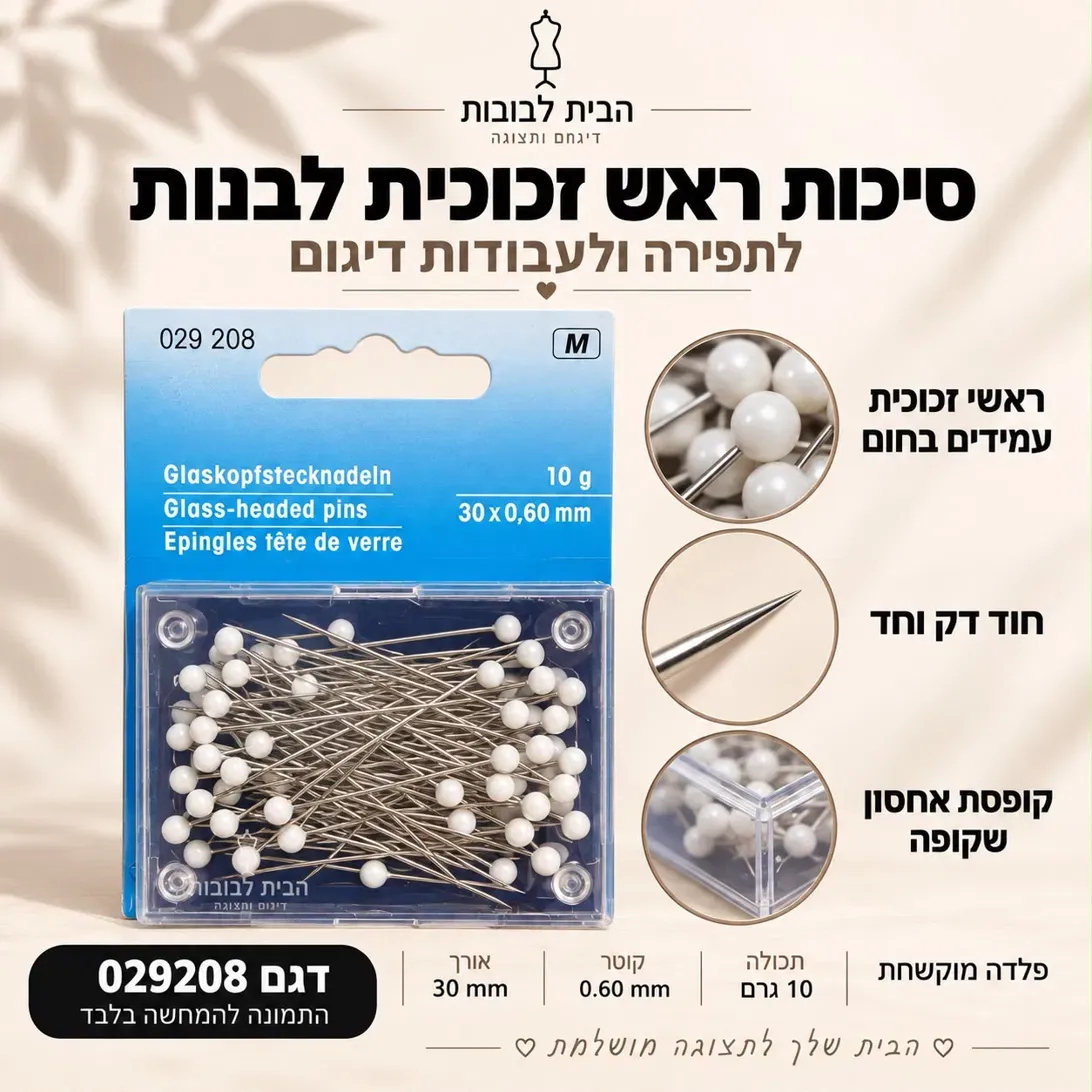
A flat metal head doesn't melt and doesn't lift the fabric. A pearl head is made of plastic, comfortable to grip and easy to spot, but it may deform or melt on contact with a hot iron. A glass head, common in sewing worldwide, doesn't melt with heat, so it's used by those who iron over pins.
Types of sewing pins: the practical difference
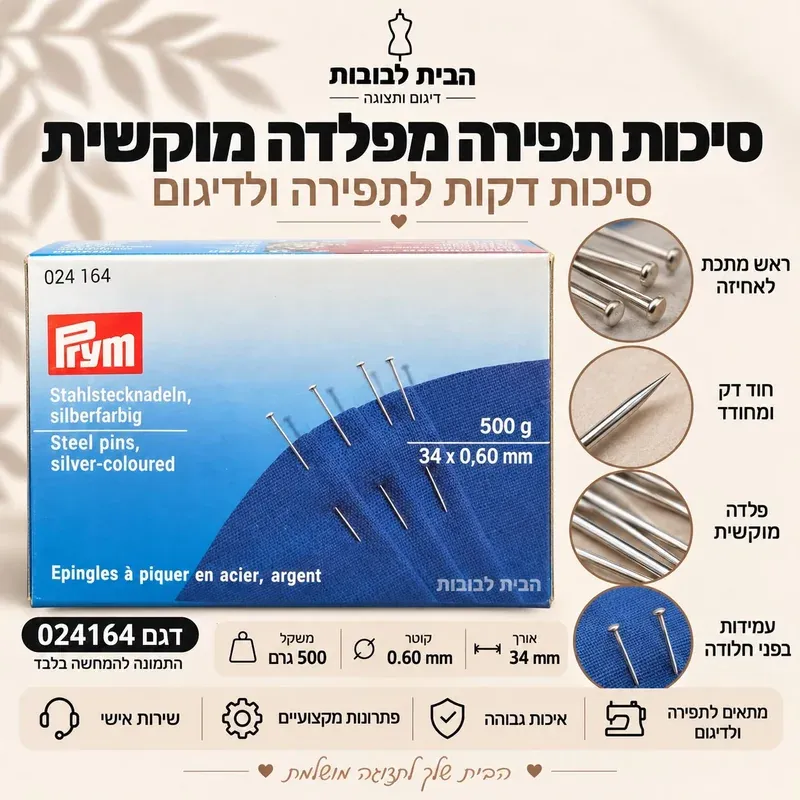
Hardened-steel pins 34×0.60 mm: PRYM hardened-steel pins, 34 mm long and 0.60 mm thick, with a fine point. Suited to pinning pattern pieces before sewing, pinning a paper pattern to fabric, marking alterations and pinning into a dress form. Sold in a 500 g pack for studios and schools, and in a 25 g octagonal box for the table and the bag.
Soft-steel pins 26×0.65 mm: shorter, thicker PRYM pins with a small metal head. Suited to crafts and decorating, flower arranging and pinning into a board, and to sewing light and medium-weight fabrics. In dense or thick fabric they bend.
Nickel-plated pins with a flat head: the flat head doesn't lift the fabric and doesn't distort a paper pattern, so they are especially handy for pinning patterns. They come in a round box with a sponge for pinning.
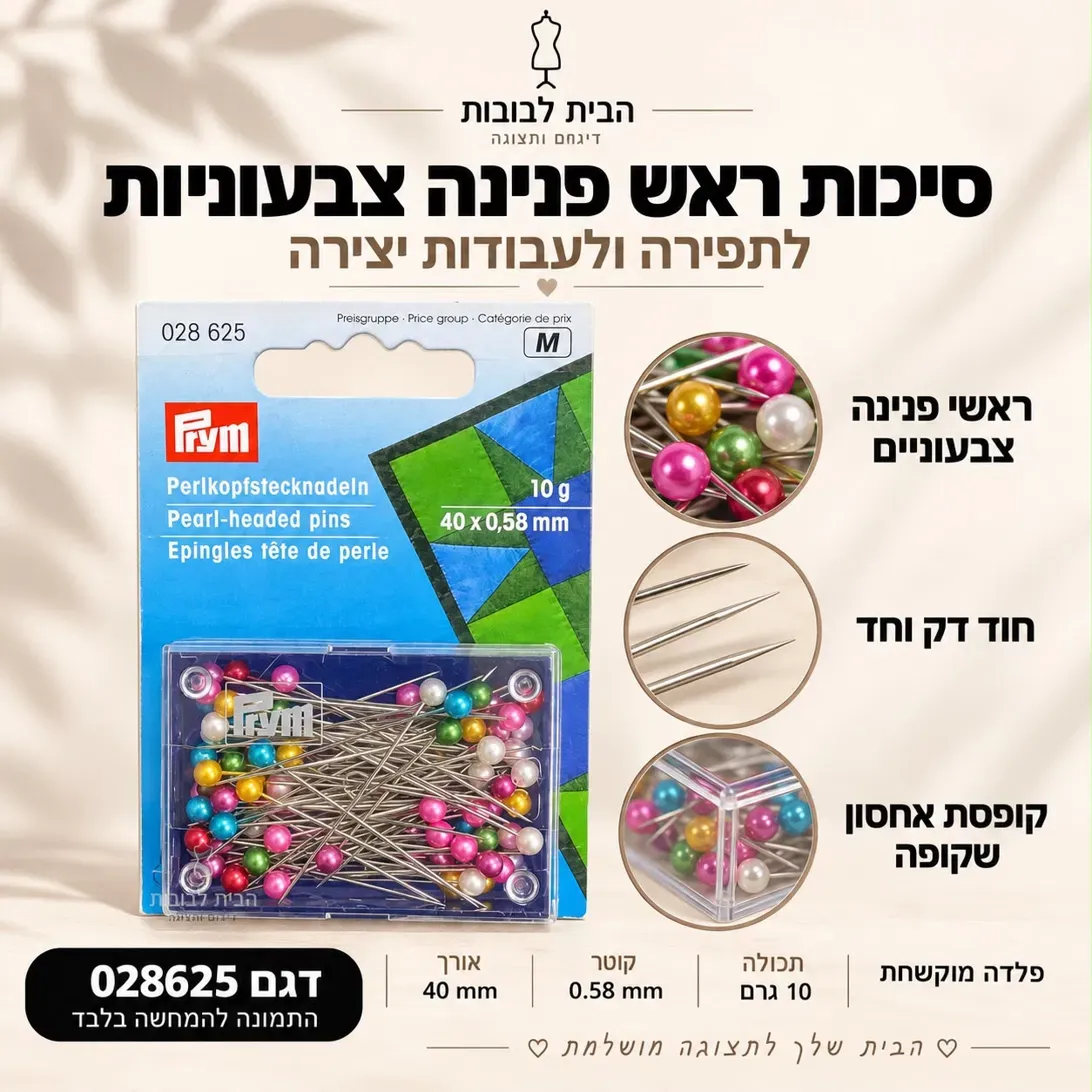
Pearl-head pins: a metal shank and a plastic head with a pearl finish, in white, black, dark shades, bright colors and pastels. Sold on a wheel, where each pin sits in its own slot, or in a clear box with a lid. Iron up to the pin, pull it out and continue.
Jeweled-head pins: a head covered with small stones. Intended for uses where the pin stays visible, such as fastening a scarf, a bridal bouquet or a decoration, rather than for hidden sewing work.
Safety pins: a pin with a closing cap and a spring coil, so the point is locked and doesn't open by accident. Used for threading elastic and cord, tagging, temporarily joining layers and temporarily closing an opening.
You can see all the types in the Pins category, and the straight pins in the Steel sewing pins subcategory.
Which sewing pins suit a dress form
Before choosing a pin, check that the form itself is designed for pinning. Sewing dress forms with a padded body and a fabric cover take a pin at any point. Display mannequins with a jersey cover over foam hold pins only partially and at an angle, and a rigid fiberglass mannequin isn't designed for pinning at all. In the Dress forms and sewing forms category, the cover material is listed for each model.
Two families of pins work well on a padded form:
Hardened steel: you pin it in and pull it out dozens of times during draping, and it returns to its shape. A soft-steel pin, by contrast, bends when pinned at an angle, and an angle is exactly how you pin into a form.
Pearl head: easy to find and pull out of the fabric on the form. When working with several colors, you can mark a seam line in one color and a button position or an alteration in another.
When photographing a garment on a form, choose a head color that blends into the fabric: a white pearl head for light fabrics and wedding dresses, and black or dark heads for dark fabrics. During draping itself, pin the fabric along the planned seam lines, in seams and darts, and avoid stretching the fabric so as not to distort the grain. If you iron the garment while it's on the form, remove the pearl-head pins first.
Pins for delicate fabrics
In delicate fabric, every hole stays. A few rules worth working by:
Choose the thinnest pin possible. For sheer fabrics and silk, pins of 0.4 to 0.5 mm are standard.
An extra-sharp point suits delicate, dense fabrics. For knits, a ballpoint suits best, as it slides between the loops without tearing them.
Pin within the seam allowance, so that if a mark remains, it disappears into the seam.
Before you start, pin a scrap of the same fabric and check whether a mark is left after the pin is removed.
The thinnest pin in the catalog is 0.60 mm thick, so with silk or chiffon it's especially important to pin within the seam allowance and test first. For bridal and evening gowns in light fabrics, white pearl-head pins are convenient to work with.
Safety pins: threading elastic and tagging
The PRYM safety pin range is numbered by size, and each size corresponds to a fixed length: 3/0 is 19 mm, 2/0 is 23 mm, 0 is 27 mm, 1 is 34 mm, 2 is 38 mm, 3 is 50 mm and 4 is 57 mm. Different manufacturers number differently, so always compare by length in millimeters. Some sizes in the range are made of hardened steel, and all have an anti-rust coating.
For threading elastic and cord: close the pin fully before inserting it into the elastic. 27 to 38 mm suit regular elastic and cords, and 50 mm suits wide elastic, because it's long enough not to turn around inside the casing.
For tagging: 19 to 23 mm suit tagging garments at laundries and dry cleaners, attaching size labels and cards, and thin fabrics. For thick fabrics such as denim, wool and fleece, 50 to 57 mm are suitable.
For visible use: gold-tone safety pins suit fastening a scarf or shawl, dresses and gift wrapping.
All sizes are gathered in the Safety pins category, individually or by the box.
Recommended pin kit by type of work
Studio and fashion school: a 500 g pack of 34×0.60 mm hardened-steel pins, pearl-head pin wheels in at least two colors for marking, and 38 mm safety pins for threading elastic.
Home sewist or student: an octagonal box of PRYM pins, a box of pearl-head pins, and a few safety pins in sizes 0 and 2.
Store, laundry and dry cleaner: a box of 1000 safety pins in size 3/0 or 2/0 for tagging.
Productions, events and floral design: 26×0.65 mm soft-steel pins for pinning into a base, and pearl-head or jeweled-head pins for visible use.
When to replace a pin
A pin that has bent or whose point is damaged leaves marks and tears fibers, so throw it away rather than trying to straighten it. Especially with soft-steel pins, a straightened pin will bend again the next time it's pinned. Anyone with a nickel sensitivity should check the metal composition on the package, since many pins contain nickel or are plated with it.
To choose pins by type of work, by fabric or by the dress form you have, browse the Pins category. For wholesale orders for a studio, school or store, or for advice, call 03-9444226, message us on WhatsApp at 055-2473993 or use the contact page.
Frequently asked questions
Can you straighten a bent sewing pin?
Not worth it. A pin that has bent or whose point is damaged leaves marks in the fabric and tears fibers. With soft steel pins, a straightened pin will bend again the next time it is inserted, so replace it with a new one.
Why does a soft steel pin bend when you push it into a dress form?
Soft steel bends easily, especially when you insert it at an angle, which is the usual way to pin into a form. For work on a dress form, a hardened steel pin is better: it is springy and returns to its shape even after repeated pinning.
Can you stick pins into a fibreglass display mannequin?
No. A rigid fibreglass mannequin isn't designed for pinning. Display mannequins with a jersey cover over foam hold pins only partially and at an angle. For draping and fittings you need a dress form with a padded body and a fabric cover that takes a pin at any point.
Which pin head color is best for photographing a garment on a form?
Choose a color that blends into the fabric so the pins don't stand out in the photo. White pearl heads suit light fabrics and wedding dresses, and black or dark heads suit dark fabrics and evening wear.
How do you use different coloured pins during a fitting?
Assign one type of marking to each head colour. For example, one colour for a seam line that needs moving, and another for a button position or a length adjustment. That way you can identify every alteration at a glance when you take the garment off the dress form or the client.
Which pin is best for pinning a paper pattern to fabric?
A straight pin with a flat head or a fine hardened steel pin. A flat head doesn't lift or distort the paper, so the pattern stays flat on the fabric during marking and cutting. A pin about 34 mm long holds both the paper and two layers of fabric.
Do sewing pins contain nickel?
Many pins are made of nickel-plated steel or contain nickel, a common cause of allergy. Anyone with a nickel sensitivity should check the metal composition listed on the package before buying.
What's better for a fashion student: a small box or a 500-gram pack?
For personal work at home and in class, a small box with a lid is handy, such as the 25-gram octagonal box, which fits in a bag and a sewing kit. A 500-gram pack suits a studio, a sewing workshop or a school that distributes pins to several workstations.
How do you thread elastic with a safety pin without it opening inside the casing?
Close the pin fully before inserting it into the end of the elastic, and choose a length that suits the width of the elastic. A 50 mm pin suits wide elastic, because it is long enough not to turn inside the casing and is easy to push forward.
How do you attach a tag to a delicate garment with a safety pin without leaving a mark?
Use a small safety pin, 19 to 23 mm, which suits fine fabrics and tagging. Insert it into the seam allowance or through an existing label in the garment, not through the front of the fabric, so the hole won't show.