Male Display Mannequin: Sizes and Dressing a Suit, Shirt and Underwear
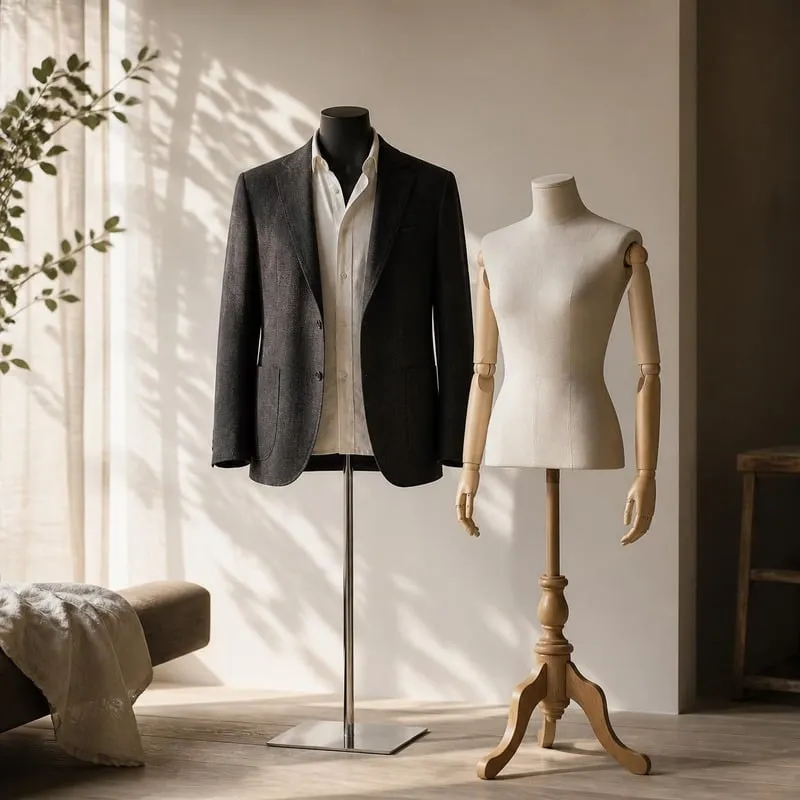
How to check whether a shirt, jacket or underwear will fit a male display mannequin: measuring the garment against the mannequin's measurements, shoulder width and collar, and dressing a suit on a torso step by step.
A male display mannequin only shows a garment well when its measurements match the garment: the garment's chest circumference should be equal to or larger than the mannequin's chest circumference, and the jacket's shoulder seam should end at the edge of the mannequin's shoulder. This guide explains how to measure a garment and compare it with the measurements of each model, how to dress a suit, shirt and sweater on a torso, and what to display on a lower torso. All measurements here are taken from the product pages.
Male display mannequin measurements: four models, four fits
Before comparing a garment, it is worth knowing exactly what each model measures. The differences between the models are big enough that the same shirt can sit perfectly on one and look loose on another.
Upper torso without arms: the black fiberglass male torso measures 102 cm at the chest, 80 cm at the waist and 47 cm across the shoulders. The body is 62 cm tall, and the pole adjusts between 5 and 55 cm. Its product page lists it as suitable for sizes M to L.
Upper torso with arms: the black torso with arms measures 100 cm at the chest and 82 cm at the waist, with a body height of 62 cm. Its listed shoulder width, 52 cm, is measured including the arms, so it cannot be compared directly with the 47 cm of the armless torso. According to the product page it fits approximately size M.
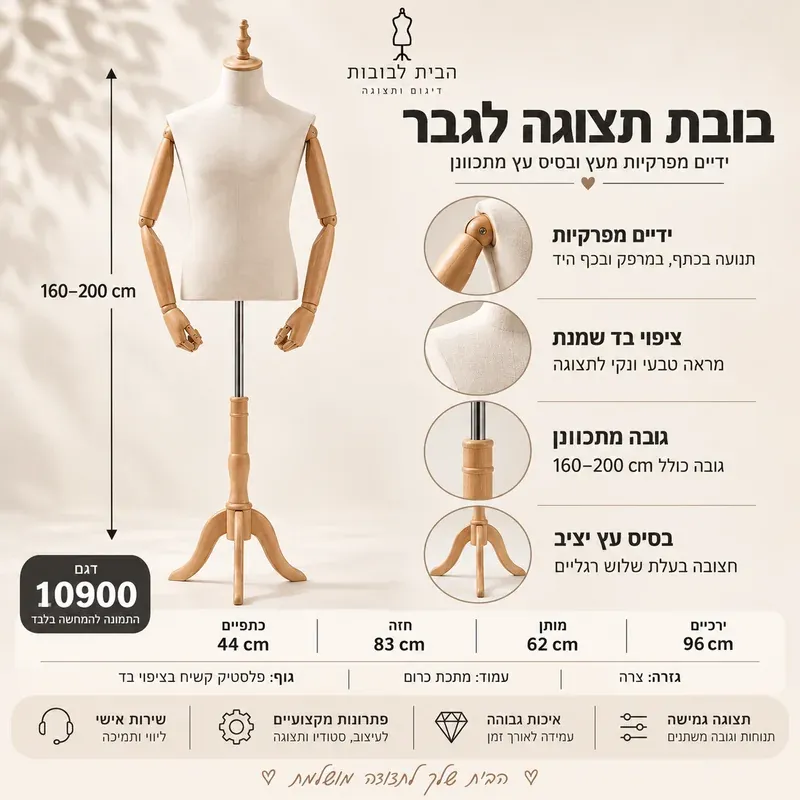
Tailor-style display mannequin: the cream fabric mannequin with articulated wooden arms is much slimmer: chest 83 cm, waist 62 cm, hips 96 cm and shoulder width 44 cm. The overall height adjusts between 160 and 200 cm. It suits slim-fit garments and small sizes.
Lower torso: the male lower torso covers the area between the waist and mid-thigh. It is 46 cm tall with a hip circumference of 96 cm. It is made of rigid skin-tone foamed plastic and stands on a flat surface without a stand.
How to measure a garment and compare it with the mannequin
Instead of guessing by the size on the label, measure the garment itself while it lies flat on a table. This is the standard method for measuring a finished jacket, and it gives numbers you can compare directly with the mannequin's specifications.
Chest: button the garment and lay it face up. Measure in a straight line from the left armpit to the right armpit, and multiply by 2.
Shoulders: turn the garment over and measure in a straight line between the two seam points at the edge of the shoulders, where the sleeve joins the body.
Sleeve length: measure from the shoulder seam to the end of the sleeve. This measurement is easier to take while the garment hangs on a hanger.
A garment's chest circumference is almost always larger than the chest of the body wearing it, because it includes ease. So the rule is simple: if the chest you measured on the garment is smaller than the mannequin's chest, the garment will not close on it properly. On the cream fabric mannequin, for example, a shirt with a chest smaller than 83 cm will gape between the buttons and look strained.
Shoulder width matters more than the chest
On a jacket or blazer, the shoulder is the first place the eye checks. The shoulder seam should end at the edge of the natural shoulder. When the jacket is too wide, the fabric slides past the edge of the shoulder and a dent forms at the top of the sleeve. When it is too narrow, the sleeve presses on the arm. On a mannequin this stands out even more than on a person, because there is no movement to hide the problem.
So compare the shoulder width you measured on the jacket with 47 cm on the armless torso or 44 cm on the cream fabric mannequin. A jacket that is a few centimeters wider than the mannequin will look big even when the chest fits. Excess at the chest can be gathered at the back, but a shoulder that is too wide cannot be hidden in a display.
The shirt collar
The collar size of a button-down shirt is measured on the shirt itself: open the collar, lay it flat and measure from the center of the button to the far end of the buttonhole. Male display mannequins have no head, and the product pages do not list a neck circumference, so there is no number to compare with. The collar does not rest on a full neck, so for a shirt with a tie, button the top button and tie the knot so the collar stays closed and neat. Without a tie, you can leave one or two buttons open.
How to dress a suit on a male display mannequin
A suit on an upper torso is displayed in layers: shirt, tie and jacket. The trousers do not go on the mannequin, because the body ends at the waistline, so hang them next to it on a hanger or fold them beside the base.
Prepare the garments. Iron or steam the shirt and jacket before dressing. A crease that goes unnoticed on a hanger stands out sharply on a body.
Set the height. Adjust the pole height before dressing. Once the garment is on the mannequin, its weight makes adjusting harder.
Shirt. On the armless torso, undo all the buttons, put the shirt on from the front and button it on the mannequin. On the torso with arms, slide one sleeve over the hand and up to the shoulder, bring the shirt around the back and then insert the other arm.
Tie. Tie it once the shirt is buttoned all the way up, and straighten the knot in the center of the collar.
Jacket. Same method: one sleeve, around the back, second sleeve. On the cream fabric mannequin you can detach the wooden arms or bend them forward, dress it, and only at the end set the shoulder, elbow and hand in their final pose.
Finishing. Gather excess fabric at the back with display clips, and hide the price tag inside the garment or attach it to a seam where it cannot be seen from the front.
On the torso with arms, check the sleeve length too. The common recommendation for suits is that the jacket sleeve should reveal between half an inch and an inch of shirt cuff, that is, about 1.3 to 2.5 cm. The same rule works in a display and gives the customer a picture of a suit that fits correctly. The jacket collar should lie gently on the shirt collar and not stand away from it.
A suit jacket is meant to cover the seat at the back, so on a torso with a body height of 62 cm the jacket hem may fall below the bottom of the body. That is fine, as long as the hem hangs straight and is not pulled to the side.
Sweaters, T-shirts and loose garments
A sweater or T-shirt without an opening goes on over the neck. On the armless torso, roll up the garment and pass it over the base of the neck. On the torso with arms, stretch the neck opening slightly and bring it over from the top before inserting the arms into the sleeves.
An oversized garment should not look tight, but it should not look sloppy either. Gather the excess at the back with clips, so that from the front the garment looks the way it should look on the customer. Pins cannot be pushed into a fiberglass or rigid plastic body, so all adjustments are made with clips, or with pins pushed into the fabric only.
Lower torso: underwear, swimwear and shorts
The lower torso ends at mid-thigh, so it suits items that end in that range: underwear, boxers, swimwear and shorts. Long trousers will not display properly on it. The product page recommends displaying a size M item on it, in line with its 96 cm hip circumference.
With underwear and swimwear, straighten the waistband first, since that is usually where the logo and elastic are. Because the torso stands without a stand, you can line up several of them on a shelf or counter, each in a different color of the same style.
Which model for which item
T-shirts, polos and short-sleeve shirts in sizes M to L: armless torso, chest 102 cm.
Jackets, blazers, short coats and long-sleeve shirts: torso with arms, chest 100 cm.
Slim-fit suits and shirts, for a boutique or tailoring studio: the cream fabric mannequin, chest 83 cm.
Underwear, swimwear and shorts: lower torso, hips 96 cm.
If you mainly sell sizes larger than L, measure your garments against these numbers before ordering, because none of the models is specified for those sizes. For general considerations of type, material and finish, for women and men, see the guide to choosing display mannequins for a clothing store.
Male torso for product photography
Photographing a shirt or jacket on a body shows the garment's volume and shoulder line, which a hanger shot or flat lay cannot show. The matte black finish of the fiberglass torso does not reflect light and makes light-colored garments stand out, and the adjustable pole lets you match the garment's height to the camera. With the cream fabric mannequin you can also control the arm pose, for example bending an elbow to show a rolled-up sleeve.
You can see all the models, with the full measurements of each, in the male display mannequins category, and the rest of our store mannequins in the display mannequins category. You can see the mannequins up close at our showroom at Kfar Giladi 15, Tel Aviv. For questions about matching a model to your merchandise or for a quote on a bulk order, contact us.
Frequently asked questions
How do you measure a jacket to know whether it will fit the torso?
Button up the jacket, lay it face up on a table, measure from armpit to armpit and multiply by 2. Then turn it over and measure in a straight line between the two seam points at the shoulder tips. Compare both numbers with the chest circumference and shoulder width listed on the mannequin's product page.
How do you hide excess fabric at the back of a fibreglass torso?
Gather the excess fabric at the centre back and secure it with display clips, so from the front the garment looks fitted to the body. You can't stick pins into a fibreglass body, so a pin, if used, goes only into the fabric itself. It's best to position the torso so its back doesn't face customers.
Why is the shoulder width of the torso with arms larger than that of the torso without arms?
On the torso with arms, the shoulder width of 52 cm is measured including the arms. On the torso without arms, the 47 cm is the shoulder width of the body alone. So the numbers can't be compared directly, and it helps to look at the bust circumference as well: 100 cm on the torso with arms and 102 cm on the torso without arms.
How do you dress a torso with arms in a jacket?
Undo all the buttons or the zipper, slide one sleeve over the hand and up to the shoulder, bring the jacket around the back and put in the other arm. Adjust the height of the stand before dressing, because the weight of the garment makes adjusting it harder afterwards.
How much of the shirt sleeve should show below the jacket sleeve?
The usual recommendation for suits is between half an inch and an inch, i.e. about 1.3 to 2.5 cm. On a torso with arms, keep to the same rule so the suit on display looks the way it should sit on a customer.
Is the cream-fabric male dress form suitable for size L shirts?
Usually not. Its chest circumference is 83 cm and its waist 62 cm, and it is built for a slim fit, so wide garments will look loose on it. For shirts and jackets in sizes M to L, a fibreglass torso with a chest circumference of 100 to 102 cm is a better fit.
What size underwear or swimwear fits the male lower torso?
The hip circumference of the male lower torso is 96 cm, and the product page recommends displaying size M items on it. Since size M varies between brands, it is worth checking the size chart of the item itself as well.
Can I use a male torso for product photography for my website?
Yes. Photographing on a body form shows the garment's volume and shoulder line better than a shot on a hanger. The matte black finish of the fiberglass torso does not reflect light, and the adjustable pole, up to 55 cm, lets you match the garment's height to the camera.
Should you iron a garment before dressing a display mannequin?
Yes. Visual merchandising guides recommend ironing or steaming every garment before dressing, because wrinkles stand out far more on a mannequin than on a hanger. A steamer also lets you refresh the garment once it is already on the mannequin.
How do you measure the collar size of a button-down shirt?
Open the collar, lay it flat and measure from the centre of the button to the far end of the buttonhole. Male display mannequins have no defined neck circumference, so on display the collar isn't meant to fit snugly around the neck, but to be closed and neat.