Tailor's Scissors: How to Choose by Cutting Length, Weight and Hand
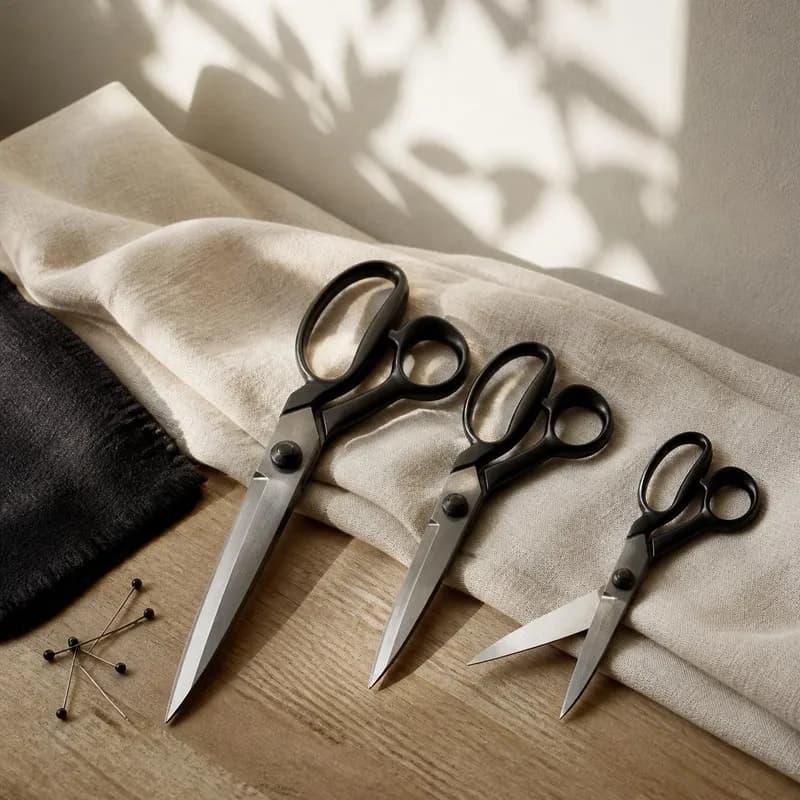
How to choose tailor's scissors by cutting length and not just overall length, by weight, ring size and right or left hand, and which blade suits each type of fabric, with checks to do before buying.
Tailor's scissors are chosen by three figures that are easy to miss on a product page: the cutting length, meaning the part of the blade that actually cuts, and not just the overall length; weight and balance relative to how much you cut and how thick the fabric is; and fit to the hand, meaning the ring size and right or left hand. Once those three are clear, you choose the blade type by the fabrics you work with: a smooth blade for stable fabrics and micro-serration for slippery fabrics. This guide goes through each of these figures with real measurements from our catalog, and finishes with checks to do before buying and sets by type of work.
Tailor's scissors: overall length vs. cutting length
The length shown in the product name is usually the overall length, from the end of the handle to the tip. For the work itself, the cutting length matters more, because it determines how much fabric is cut with each close. Two pairs with the same overall length can behave completely differently on the table.
A few examples from the catalog show the gap:
Kretzer FINNY PROFI tailor's scissors: overall length 25 cm, cutting length 12 cm.
D.PERES SOLINGEN professional scissors: overall length 23 cm, blade 10 cm.
D.PERES SOLINGEN TURBO: overall length 20 cm, blade 8 cm.
Tailor's shears, large model: overall length 30 cm, blade 20 cm.
Note that manufacturers measure the blade in different ways. Kretzer defines cutting length from the screw to the tip, while other manufacturers simply write "blade length". So compare this figure between models that publish it using the same definition, and not just between numbers from different manufacturers.
How this translates into work: when cutting correctly, you don't close the blades all the way but to about two thirds, and continue. With a cutting length of 12 cm, each close advances the line by about 8 cm. A long blade shortens the long straight lines of a dress, coat or curtain. A short blade gives more control at necklines, armholes and notches. Someone who mainly cuts children's clothing or patterns with lots of curves won't benefit from a long blade, while someone who cuts full-width fabrics will feel every centimeter of blade.
Weight and balance: when a heavy pair helps and when it tires you
Weight is not a measure of quality. It is a working tool you match to the type of cutting. A heavy pair sits steadily on the table, and the weight helps the blade pass through wool, denim and layers. A light pair suits hours of cutting lightweight fabrics and precise work on curves, and tires the wrist less.
Most manufacturers don't publish the weight, so it's worth identifying it by the construction:
Plastic handles with soft rings: relatively light and comfortable for extended work. This is how the PRYM Professional series is built, with a handle that includes soft inner rings.
Two-component handle: a rigid body with a soft anti-slip insert. On the Kretzer FINNY PROFI the published weight is about 120 grams, a weight that feels stable without being heavy.
Metal handles: heavier and give the feel of a classic tool, as on the PRYM Gold Edition or tailor's shears with metal handles. Suited to those who cut thick fabrics and layers.
With long, heavy scissors, working height matters too. On a cutting table at the right height, the weight falls on the blade and not on the wrist, and the lower blade glides along the surface without having to be lifted.
Fit to the hand: rings, grip and dominant hand
Ring size and the correct grip
On classic tailor's scissors, the small ring is for the thumb and the large one for two or three fingers, with the index finger able to support from the outside. With thick fabrics you put all your fingers into the large ring and close with the whole hand. If the ring is too narrow, its edges press on the fingers after just a few minutes. If it is too wide, the scissors wobble and the line comes out less precise. So, when possible, it's worth holding the pair in your hand before buying and making a few full closes.
Left-handers: blade order matters, not handle shape
While cutting, the thumb pushes slightly sideways, and that pressure is what presses the blades against each other. With right-handed scissors held in the left hand, the same pressure pushes the blades apart. The fabric gets caught and folds between them instead of being cut, and the upper blade hides the marking line.
The solution is a reversed blade order, not just a symmetrical handle. The test is simple: hold the scissors in cutting position. On a left-handed pair, the left blade is on top of the right blade. The 21 cm PRYM Professional left-handed tailor's scissors are built this way. Scissors with symmetrical handles only solve grip comfort, and mainly suit a classroom or workshop where several people use the same pair.
Blade type: smooth, micro-serrated and tip
Smooth blade: cuts cleanly and quietly through cotton, linen, wool and stable apparel fabrics, and is easier to sharpen. For most everyday work, this is the right blade.
Micro-serration: tiny teeth along the edge that grip the fabric at the moment of closing, so the fabric doesn't slip forward between the blades. On the D.PERES SOLINGEN TURBO with micro-serration, the serration is on one blade and the other blade is smooth. The serration makes a difference on satin, silk, chiffon and lining. This blade should only be sharpened by a sharpener who knows the type, because ordinary sharpening can erase the teeth.
Fine tip: a sharp, precise point, as on the Kretzer FINNY PROFI, lets you cut right to the end of the marking, get into notches and cut tight into a corner without switching pairs.
Matching tailor's scissors to the type of fabric
Silk, satin, chiffon and lining: micro-serration and a length of about 20 cm for control. Secure the fabric with pins or weights and close slowly and continuously.
Jersey and knit fabrics: fabric that tends to shift and stretch. Keep it flat on the table, don't pull it toward the scissors, and micro-serration helps here too.
Cotton, linen and viscose: a smooth blade of 21 to 23 cm covers most patterns.
Wool, denim, canvas and coat fabrics: 25 to 26 cm, a stable pair and closing with the whole hand.
Layers and folded fabric: a long blade, as on the 30 cm model with a 20 cm blade. Secure the layers, don't stack too many, and with thick layers tighten the screw slightly so the blades don't spread apart.
Faux fur: work from the reverse side, one layer, and cut only the backing using the tip, so the hairs aren't trimmed.
Five checks before you buy
Grip: the thumb and fingers fit into the rings without pressure and without excess play.
Smooth action: the blades close evenly from the base to the tip, with no point where you need to press harder.
Cutting at the tip: the tip cuts a thin piece of fabric rather than folding it.
Adjustable screw: an adjustable pivot screw lets you adapt the tightness to the fabric thickness over the years.
Hand: left-handers check the blade order, not just the handle shape.
Sets by type of work
Home sewing: one pair of 21 to 23 cm with a smooth blade, and a separate pair for pattern paper.
Evening and bridal wear studio: a pair with a smooth blade for general cutting and a pair with micro-serration for slippery fabrics.
Tailoring and winter wear: a long pair of 25 cm and up for thick fabrics and layers, and a short pair for details.
Fashion schools and workshops: a uniform length for all students, for example from the professional 8–12 inch tailor's scissors that come in five lengths between 20 and 30 cm, and at least one left-handed pair in every class. Wholesale quotes are given according to quantity, by phone at 03-9444226 or on WhatsApp at 055-2473993.
Maintenance in brief
Tailor's scissors cut fabric only. Wipe lint from around the screw, add a drop of machine oil now and then, and store them closed. A fall on the floor can damage the alignment between the blades. Sharpening and steel selection are a topic in their own right and are best left to a professional.
All models, with overall length, blade length and handle type, are in the Tailor's Scissors and Fabric Scissors category. German-made models from D.PERES and Kretzer are gathered under Solingen Scissors, and embroidery scissors, thread snips and paper scissors are on the All Scissors page. For advice on the right pair for your fabrics and type of work, you can reach us by phone or WhatsApp.
Frequently asked questions
What is the difference between overall length and cutting length in tailor's shears?
Overall length is measured from the end of the handle to the tip of the blade, and cutting length is the part of the blade that actually cuts, from the screw to the tip. Cutting length determines how much fabric is cut with each close. For example, the Kretzer FINNY PROFI has an overall length of 25 cm and a cutting length of 12 cm.
How do I know if tailor's shears fit the size of my hand?
Your thumb should fit into the small ring and two or three fingers into the large ring, without pressure and without excess play. After a few full closes there should be no pressure point on your fingers. For a small hand it is usually comfortable to start with a length of 20 to 21 cm, because a long pair is heavier during extended work.
Do heavy tailor's shears cut better?
Not necessarily. Weight helps with thick fabrics and layers, because the pair sits steadily on the table and the weight helps the blade go through the fabric. For long sessions cutting light fabrics, a light pair is less tiring and gives more control on curves. Cutting quality depends on sharpness and on how tightly the blades meet.
Why do regular scissors chew fabric when you cut left-handed?
While cutting, the thumb pushes slightly sideways, and in right-handed scissors that pressure brings the blades together only when you hold them in your right hand. In the left hand the same pressure pushes the blades apart, and the fabric gets caught and folds between them instead of being cut. On top of that, the upper blade hides the marking line.
What is the difference between scissors with symmetrical handles and left-handed scissors?
With symmetrical handles, both rings are the same size, so the grip is comfortable in either hand, but the blade order stays the same as on right-handed scissors. On left-handed scissors the blade order is reversed, with the left blade on top. For precise, extended cutting with the left hand, a dedicated left-handed model is better.
Which scissors suit cutting jersey and knit fabrics?
Sharp fabric shears with micro-serrated blades help, because the serrations grip the fabric and stop it from shifting as the blades close. It is important to keep the fabric flat on the table and not pull it toward the shears. A length of about 20 to 23 cm gives good control on the curves of knit garments.
How do you cut faux fur without chopping the pile?
Work from the wrong side of the fabric, in a single layer, and mark the pattern with chalk on the backing. Cut with sharp scissors with a fine point, inserting only the tip so that just the backing is cut. That way the pile stays intact and doesn't scatter across the table.
How many layers of fabric can you cut at once with tailor's shears?
There's no fixed number; it depends on the thickness of the fabric and the length of the blade. Long shears, such as a 30 cm model with a 20 cm blade, are built for layers. The sign that the stack is too high is that the blades spread apart, the bottom layer shifts or the line comes out crooked. In that case, reduce the layers and secure them with pins or weights.
Why is an adjustable screw important on tailor's shears?
The screw determines how tightly the blades meet. An adjustable screw lets you tighten slightly when cutting thick layers so the blades don't spread apart, and restore the tension after long use. A pair that closes with an even motion from the base to the tip is correctly adjusted.
Which tailor's shears should I buy for a fashion school class?
It is practical to choose one model in a single length so that all students learn on the same tool, and to add at least one left-handed pair per class. A model that comes in several lengths lets you offer a shorter pair to students with small hands. Wholesale quotes are given by quantity, by phone at 03-9444226 or on WhatsApp at 055-2473993.


