הבית לבובות דיגום ותצוגה
Tailor's Shears – 25.4 cm (10 in.), Long Stainless Steel Blade for Heavy Fabrics
In stock
SKU: 1010610
Product description
Tailor's shears 25.4 cm long: the long model in the series
Tailor's shears, 25.4 cm (10 in.) long. The long blades are made of stainless steel and suit thick fabrics, two folds of fabric and large patterns of coats, long dresses and pants.
A reinforcing screw holds the blades tight along the whole length, and the black handles in an asymmetric design transfer force from the whole palm. On a large cutting table this saves closings and gives a long, continuous line.
How this model differs from our similar models
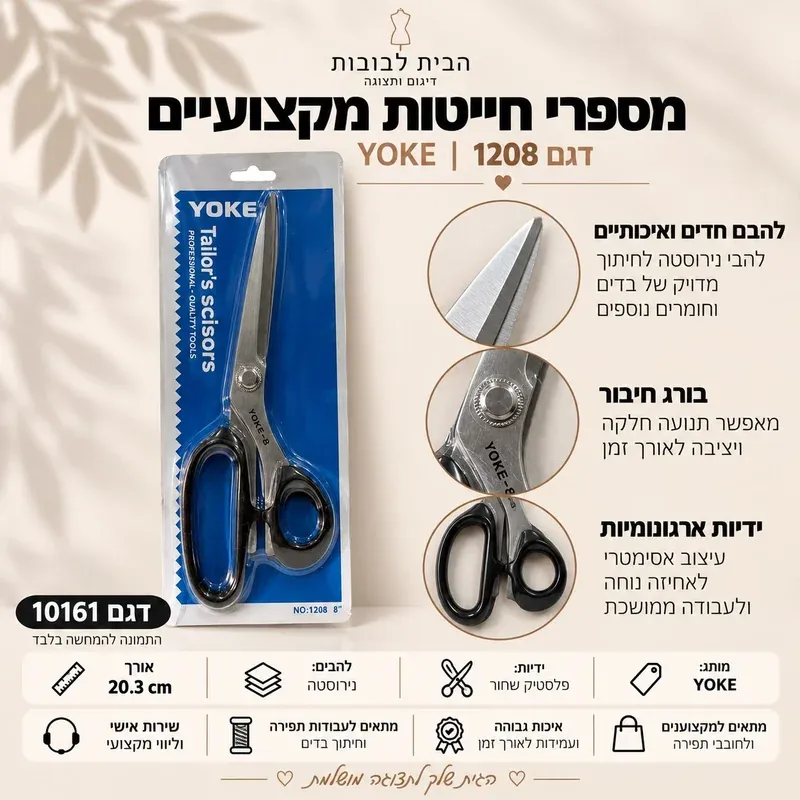
20.3 cm: The lightest and most compact in the series, for control on curves and details
22.9 cm: A middle size for most fabric work
25.4 cm (the model on this page): A long blade for thick fabrics, layers and large patterns
Common uses
Cutting wool, thick denim, canvas and upholstery fabrics
Cutting two layers of folded fabric
Patterns for coats and long dresses
Curtains and tablecloths
Production work in a studio
Who the scissors are for
Tailors: For suit and coat fabrics
Workshops and studios: For heavy work on a cutting table
Upholstery and home textile sewists: For heavy fabrics
Fashion design schools: For quantity orders you can contact us
Tips for working with long scissors
Work on a wide table: The lower blade needs room to move on the surface
Hold layers before cutting: Pins or weights prevent shifting
Switch to short scissors for details: Corners and notches are easier to cut with short scissors
Common mistakes and how to avoid them
Too many layers at once: The line drifts and the screw loosens
Cutting paper and plastic: Dulls the long blade
Falling off the table: Damages the tip and the fit of the blades
How to keep tailor's shears for years
Good tailor's shears can serve for many years, if you keep a few habits:
Fabric only: Paper, adhesive tape and plastic quickly dull the blade
Wipe after work: Lint and fabric fibers build up near the screw and affect the closing
A drop of oil on the screw: Now and then a small drop of sewing machine oil at the joint, and wipe off the excess
Closed, dry storage: Open scissors get damaged at the tip, and moisture harms the steel
Don't drop: Falling on the floor can bend the tip or change the tightness between the blades
Professional sharpening: When the scissors start chewing the fabric, take them to a sharpener rather than sharpening at home
Images are for illustration only; slight color differences may occur between different screens.
Specifications
Product type: Tailor's shears
Total length: 25.4 cm (10 in.)
Blades: Stainless steel
Joint: Reinforcing screw
Handles: Black plastic, asymmetric design
Sold as: Per unit
Frequently asked questions
Frequently asked questions
Which fabrics are 10 inch scissors suitable for?
Thick fabrics such as wool, thick jeans, canvas and upholstery fabrics, and two layers of folded fabric.
What are the blades made of?
Stainless steel. The handles are black plastic and the joint is a reinforcing screw.
Are long scissors heavy to work with?
They are slightly heavier than the short models, but the long blade saves closings, and the asymmetrical handle spreads the force across the whole palm.
Are the scissors suitable for left-handed users?
The asymmetrical handle is designed for the right hand. Anyone who cuts with their left hand will prefer dedicated left-handed scissors, in which the order of the blades is reversed.
How do I cut properly with a long blade?
Lay the fabric flat on the table, keep the bottom blade flat against the surface, and close the scissors only about two-thirds of the way before moving forward. That way the line stays continuous with no steps.
How do you keep the scissors sharp?
Cut only fabric, wipe after working with interfacing or coated fabrics, add an occasional drop of oil to the screw and store them closed in a dry place.