Dress and Suit Covers: How to Choose Material, Length and Depth

A guide to choosing a dress or suit cover: non-woven fabric, PEVA or a PE bag, how to measure length, when you need a gusset, and how to store a wedding dress long-term.
A dress or suit cover is chosen based on three things: material, length and depth. For long-term closet storage, choose breathable non-woven fabric. For travel and transport, choose water-resistant PEVA. For handing a garment back to a customer after cleaning or alterations, a thin PE bag is enough. Length is measured from the top of the hanger to the hem of the garment, plus about 10 cm. A wedding dress or an evening gown with a full skirt needs a cover with a side gusset. In this guide, we go through each of these decisions.
Three Materials, Three Uses
Non-Woven Fabric
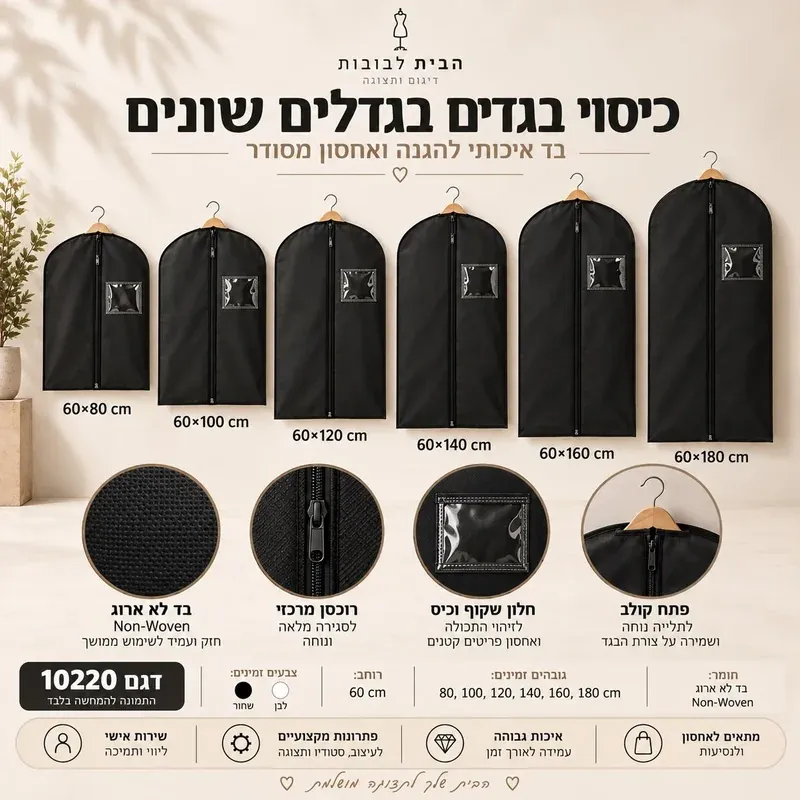
Non-woven fabric is the standard material for garment storage covers. It breathes, meaning air passes through it, so moisture doesn't get trapped inside. This is especially important for natural fabrics such as wool, silk and cotton, which are damaged by prolonged moisture. It also blocks light better than clear plastic, protecting the garment's color.
Most of our non-woven covers come with a full-length zipper, a hanger opening and a clear ID window, so you can see what's hanging inside without opening it. The non-woven cover with ID window comes in six lengths, from 80 to 180 cm.
PEVA
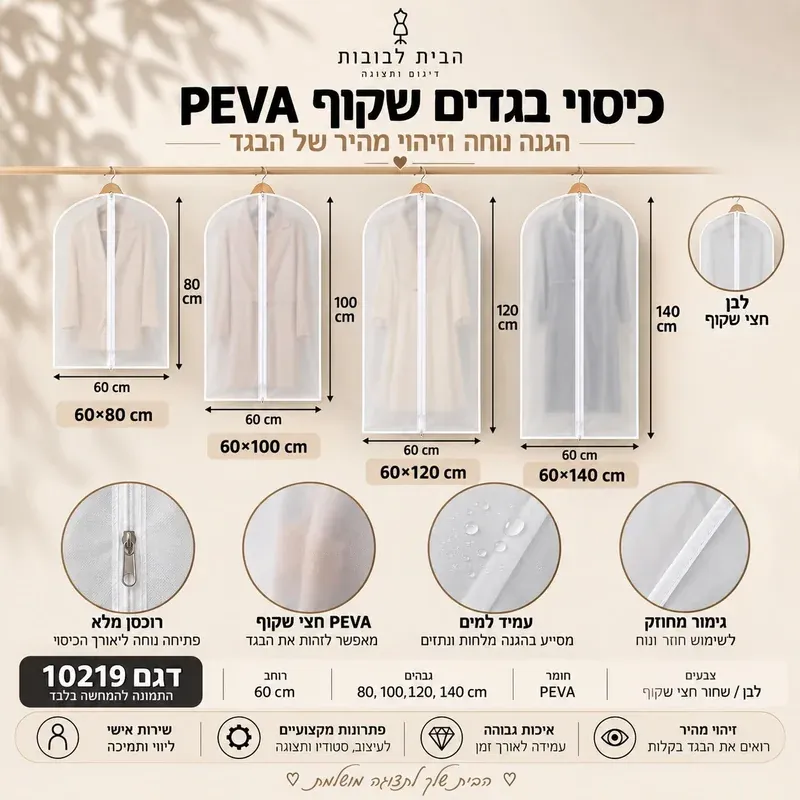
PEVA is a flexible plastic material, thicker than a plastic bag, and water-resistant. It's ideal for carrying, travel and transport, when the garment moves from home to the venue or from the store to the customer. It wipes clean easily and holds up to repeated use. What it doesn't do is breathe, so don't leave a garment in it for months in a closet. It's also available in a semi-transparent version, like the semi-transparent zippered PEVA cover, and with carry handles, like the 180 cm white PEVA cover.
Thin PE Bag
A clear plastic bag with no zipper that slips over the garment from above the hanger. It's the basic layer used by dry cleaners, tailors and stores, for handing over a garment or keeping hanging merchandise dust-free. It's cheap, light and transparent, but it doesn't breathe and isn't meant for long-term storage. Clear PE bags are sold in five sizes, 45 to 140 cm long.
How to Choose the Length
Measure from the top of the hanger to the hem of the garment, and add about 10 cm so the hem doesn't stick out at the bottom or touch the closet floor. Here's how it looks in practice:
80–100 cm: shirts, jackets, blazers and short dresses.
120 cm: a full suit on one hanger and knee-length dresses.
140 cm: long coats and midi dresses.
180 cm: evening gowns, wedding dresses and maxi dresses.
The standard width is 60 cm, which fits a regular adult hanger. A garment with wide shoulders or a thick suit hanger sometimes needs more room.
When You Need a Cover with a Gusset
A flat cover suits a garment that hangs straight. A dress with a full skirt, layers of tulle or thick shoulder pads gets crushed inside it and comes out creased. A cover with a side gusset gives the garment room.
8 cm gusset: for suits, heavy coats and evening gowns with a little volume. For example, the gray cover with an 8 cm gusset.
25 cm gusset: for wedding dresses and full evening gowns. For example, the wedding and evening gown cover, 70 cm wide and 180 cm long.
How to Store a Wedding Dress or Evening Gown Long-Term
Clean before storing. Makeup, sweat or drink stains oxidize over time and turn yellow, even if you can't see them now.
Cover only a completely dry garment. A dress that's still damp from cleaning or warm from pressing creates condensation inside the cover.
Choose a breathable fabric. For storage of several months, use non-woven fabric, not plastic or PEVA.
Hang it on a wide, sturdy hanger. For a heavy dress, use its inner hanging loops, if it has them, so the weight doesn't stretch the shoulders.
Store it in a dark, dry, cool place. Not next to a damp exterior wall and not in a rooftop storage room.
Open and air it every few months. Check for new stains or a musty smell.
Covers for Businesses: Bridal Salons, Stores and Designers
In a business, the cover is part of the customer's experience. A dress that leaves the salon in a clean cover, the right length and with an ID window, looks different from one that leaves in a bag. It's worth keeping stock in several lengths and choosing one color for the whole business: white for a clean look, black when the cover passes through many hands.
You can also print your business logo on the cover. We offer logo printing on garment covers, by screen printing or digital printing, with a mockup for approval before production, from a minimum of 30 units. The full range is in the Dress & Suit Covers category, and for bulk orders you can contact us for a wholesale quote.
Common Mistakes
Storing for months in a plastic bag: plastic doesn't breathe, and moisture trapped inside damages the fabric.
Choosing a cover that's too short: the hem stays exposed and is the first thing to get dirty.
Squeezing a full dress into a flat cover: the skirt gets crushed and comes out wrinkled.
Hanging a heavy dress on a thin hanger: the shoulders stretch and get bumps.
Covering a damp garment: condensation forms, followed by stains and odor.
Frequently asked questions
What is the difference between a non-woven fabric cover and a PEVA cover?
Non-woven fabric breathes, so it suits long storage in a closet. PEVA is waterproof and washes easily, so it suits carrying, travel and reuse, but not storage for months.
What cover length does an evening gown need?
Usually 180 cm. Measure from the top of the hanger to the hem of the gown and add about 10 cm.
Do I need a special cover for a wedding gown?
Yes, if it has a puffy skirt or tulle layers. A cover with a 25 cm side gusset preserves its volume.
Can I keep a suit in the laundry's plastic bag?
For a few days, yes. For long storage, switch to a non-woven fabric cover, because nylon does not breathe.
Can I print a logo on garment covers?
Yes. Printing is done by screen printing or digital printing, with a mockup for approval before production, from a minimum of 30 units.
How much does a suit cover cost?
The price depends on the material, the length and the quantity. A PE bag is the cheap option, a non-woven cover with a central zipper costs more, and PEVA or a cover with a gusset costs even more. The price of each model appears on the product page, and for business quantities a wholesale price is given.
What is non-woven fabric?
Another name for non-woven fabric: fibers that are pressed and bonded together without weaving. It is light, breathable and opaque, so it is the common material for garment covers for storage.
How do you clean a garment cover?
Wipe a PEVA cover with a damp cloth and dry it before putting a garment in. Shake dust off a non-woven cover and air it out. Don't iron the cover at high heat.
Why is an identification window needed in the cover?
To see what is hanging inside without opening it. In a salon or laundry with dozens of garments on the rack this saves time, and in the clear pocket you can put a note with the customer's name and the handover date.
What is the difference between a dress cover and a suit cover?
Mainly the length and the gusset. For a suit, a cover of 100 to 120 cm is usually enough, with a small gusset if the hanger is thick. An evening gown usually needs 180 cm, and a puffy gown needs a gusset too.