
Pins
Sewing pins and safety pins for dressmakers, designers, tailors and event decorators: Prym straight pins in hardened steel and soft steel in 500 g packs and small boxes, pearl-head and rhinestone-head pin wheels in white, black and colours, and Prym safety pins in lengths from 19 to 57 mm alongside silver and gold safety pins. Retail and wholesale, self-pickup in Tel Aviv and shipping nationwide.
Products: 31



Pins by Type
Safety pins: Prym pins in lengths from 19 to 57 mm, silver safety pins and gold-tone pins.
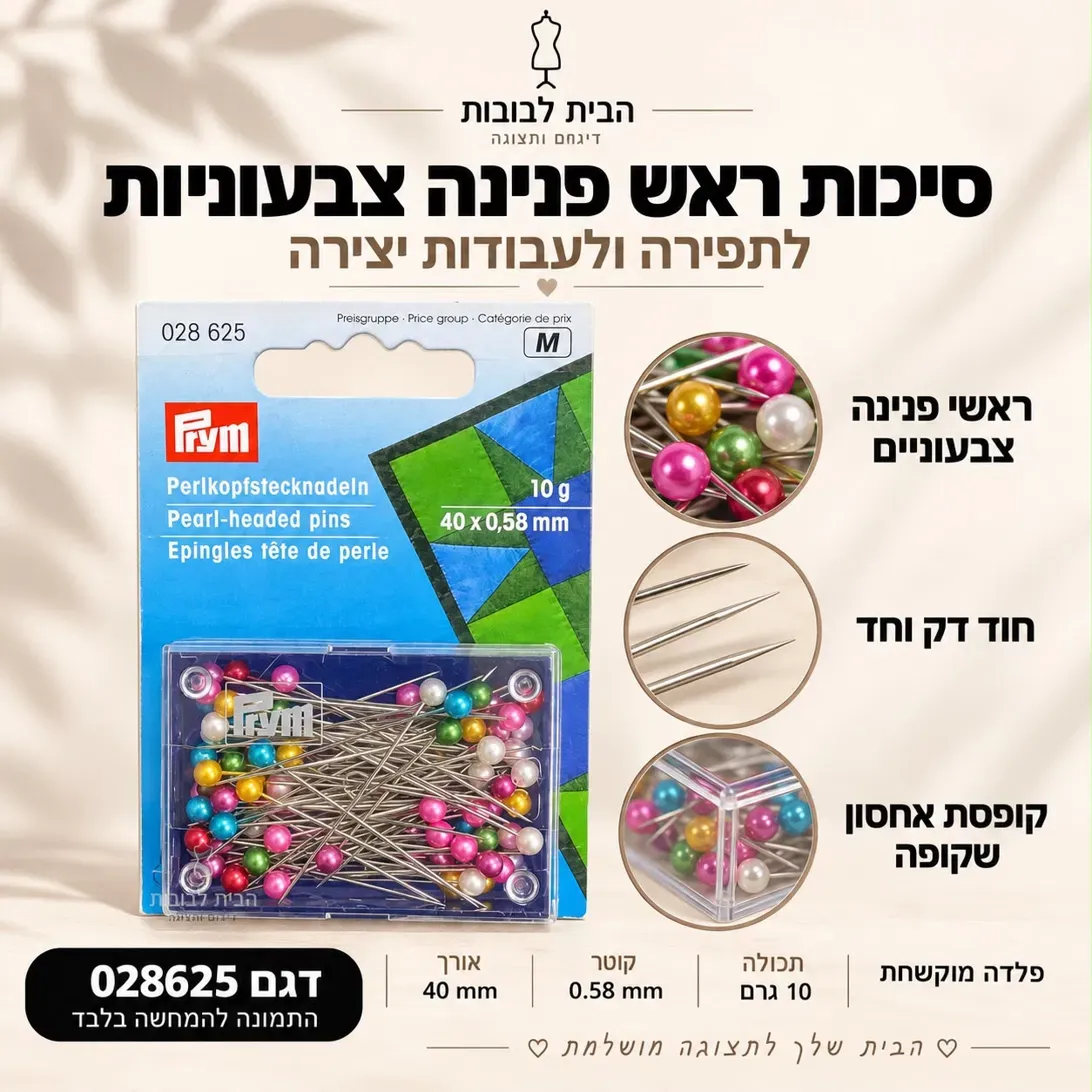
Pearl-head and rhinestone-head pins: pin wheels and storage boxes in white, black, silver and colours, for sewing, draping and visible use.
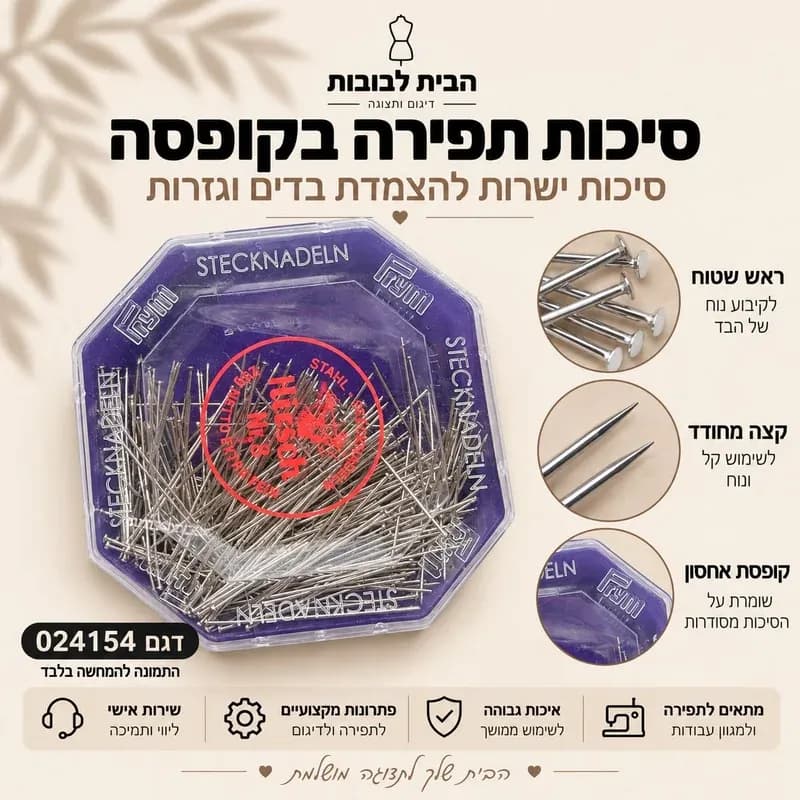
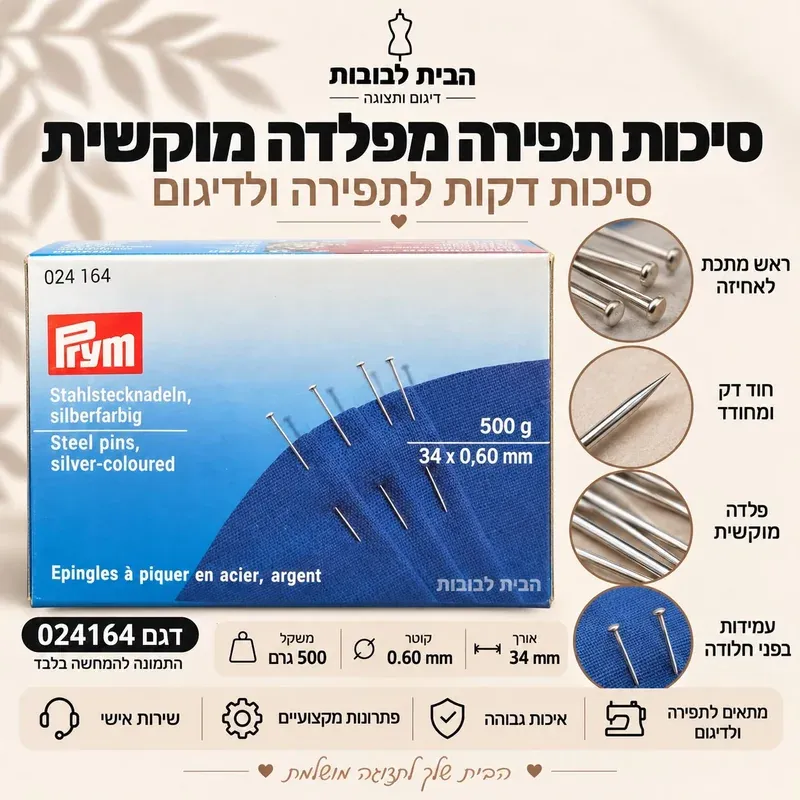
Steel sewing pins: Prym pins in sizes 34×0.60 mm and 26×0.65 mm, in 500 g packs and an octagonal box, plus nickel-plated pins in a round box.
Sewing Pins: What Holds the Garment Before It Is Sewn
Before every seam, the fabric is pinned: two pattern pieces to each other, the paper pattern to the fabric, or the fabric to the dress form during fitting. A pin that is too thick leaves a hole in delicate fabric, a soft-steel pin bends in thick layers, and a plastic head can warp under the iron. This category has three families: straight steel sewing pins, pearl-head and rhinestone-head pins, and safety pins. The pins are part of the sewing supplies category, alongside needles and rulers.
Types of Pins in This Category
Straight Steel Sewing Pins
Prym hardened steel 34×0.60 mm: a straight pin 34 mm long and 0.60 mm thick, with a fine, sharp point and a head that is easy to grip. According to the manufacturer it has a balanced springiness and is rust-resistant. Sold in a 500 g pack for sewing workshops and tailors, and in a 25 g octagonal box for the worktable, bag and sewing kit.
Prym soft steel 26×0.65 mm: a shorter pin with a small metal head, in a 500 g pack. Soft steel bends easily, so these pins suit crafts, decoration, flower arranging and sewing light fabrics. They are not stainless steel.
Nickel-plated flat-head pins: straight pins in a clear round box with a foam insert for pinning. The flat head does not lift the fabric or catch on it, and the nickel plating helps protect the pin from rust.
Pearl-Head and Rhinestone-Head Pins
Pearl head: a metal shaft and a round plastic head with a pearl finish, easy to grip and to spot on the fabric. Wheels are available in white, glossy black or dark grey, dark shades, bright colours and pastel shades, plus two clear storage boxes with long, fine pins in pearl white and silver-grey. On the wheel each pin sits in its own slot, so you can see at a glance how many are left. The head is not iron-safe.
Rhinestone head: a round head covered in small light-reflecting stones, on wheels in white, black, alternating black and white, and mixed colours. Choose them when the pin stays visible and is part of the look: in bridal bouquets and boutonnieres, for securing a veil, headscarf or shawl, and in costumes.
Safety Pins
Prym steel: six sizes, from 3/0 (19 mm) through 2/0 (23 mm), 0 (27 mm) and 2 (38 mm) up to 3 (50 mm) and 4 (57 mm), with an anti-rust coating. The head has no sharp edges and the spring is balanced, so the pin closes easily and stays closed. Supplied in a Prym box of 1000 and sold individually or by the full box.
Silver and gold safety pins: pins with a sharp point, a closing head and a spring coil. The silver ones come in sizes 0, 2, 3 and 4, for sewing, tagging and household use. The gold ones are suitable when the pin stays visible and needs to match gold buttons and accessories.
How to Choose Pins for the Job
Everyday sewing on woven fabrics: Prym straight pins 34×0.60 mm. The length is enough for two layers of fabric, and they are thin enough for most fabrics.
Delicate fabrics such as silk, chiffon and satin: a thin pin with a sharp point, pinned only within the seam allowance so the hole does not show. Test on a scrap of the same fabric before you start.
Marking during measuring and fitting: coloured pearl-head pins, which stand out on the fabric and let you tell markings apart. On a dark garment photographed on a form, work with black or dark-toned heads that will not stand out in the picture.
Crafts and decoration: Prym soft steel pins 26×0.65 mm.
Bouquets, headscarves and events: rhinestone-head or pearl-head pins in a shade that matches the fabric.
Threading elastic and thick layers: safety pins. 38 mm is a common size for threading elastic, and 50 or 57 mm suit thick layers and wide elastic.
Leather and faux leather: every hole stays in the material, so never pin in the visible area, only within the seam allowance.
Pins for Working on a Dress Form
When working on a form, pins hold the fabric to the body during draping, pattern making and fitting. A form with a padded body, such as the pinnable women's dress form, takes straight pins and pearl-head pins. Never pin into a rigid fibreglass display mannequin.
Pin diagonally: an angled pin holds the fabric better and does not slip out when you move it.
Pin along the seam line: when fitting on the form, pin parallel to the future seam line so you can see the line and mark it.
Match the head colour to the fabric: a white head on light fabric and a black head on dark fabric when the garment is photographed on the form.
Information on choosing a form by size is in our guide to choosing a dress form, and forms for women's patterns are in women's dress forms.
Professional Tips
Perpendicular to the seam line: when pinning before machine sewing, place the pins perpendicular to the line with the head facing out, and remove each pin before the needle reaches it.
Don't sew over pins: when the needle hits a pin, it damages the needle point and can break it. Replace any needle that has hit a pin.
Don't iron over a plastic head: a pearl head can warp or melt on contact with a hot iron. Iron up to the pin, pull it out and continue. Press curved seams on a pressing ham.
Count pins on light fabric: a white pin on white fabric is hard to see, so count how many pins came off the wheel and return each one to its place.
Throw away a bent pin: a bent or blunt pin tears fibres and leaves a mark even on sturdy fabric.
Caring for Your Pins
A rusty pin leaves a brown stain on fabric that is very hard to remove. Store pins in a dry place, on their wheel or in their closed box, and don't leave them pinned in damp fabric for a long time. Nickel-plated pins and safety pins with an anti-rust coating are more resistant, but they also need dry storage.
Related guide: Types of sewing pins: steel, pearl-head, safety pins and which suit a dress form
Wholesale Pins for Studios and Sewing Schools
Pins are a consumable, and in a sewing class, studio or workshop they get lost and replaced all the time. HaBayit LaBubot sells sewing pins and safety pins wholesale to sewing schools, fashion programmes, sewing workshops, event decorators and stores. Prym safety pins are also sold in boxes of 1000, and straight pins in 500 g packs. For a quantity-based price quote, call 03-9444226, message us on WhatsApp at 055-2473993 or reach us via Contact Us. You can order online and pick up from 15 Kfar Giladi or 17 HaMashbir in Tel Aviv, or have it shipped according to the terms on the Shipping and Returns page.
Frequently asked questions
Which pins suit most sewing jobs?
For most work on woven fabrics, straight pins made of hardened steel are suitable, such as Prym 34×0.60 mm. The length is enough for two layers of fabric, and the fine point passes through the fabric without damaging the fibers. For marking and working on a dress form, it is handy to add a wheel of pearl-head pins, whose heads are easy to grip and stand out on the fabric.
Can you iron with pearl-head pins still in the fabric?
Not over the head. The pearl head is made of plastic, and in direct contact with a hot iron it can warp or melt. Press up to the pin, pull it out and keep pressing.
What is the difference between pearl-head pins and studded-head pins?
A pearl-head pin has a smooth plastic ball head with a pearl finish and is used mainly for pinning patterns, marking and draping. A jewelled-head pin has a head covered in small light-catching stones, and is chosen when the pin stays visible, for example in a bridal bouquet, a veil, a headscarf or a costume.
Which pins are suitable for working on a dress form?
On a dress form with a padded body, use straight pins or pearl-head pins, and insert them at an angle so the pin holds and doesn't slip out. The form must be designed for pinning, like the pinnable dress form. Never push pins into a rigid fibreglass display mannequin.
What do safety pin sizes mean?
In the Prym safety pin range, size 3/0 is 19 mm, 2/0 is 23 mm, 0 is 27 mm, 2 is 38 mm, 3 is 50 mm and 4 is 57 mm. The small sizes suit labeling and thin fabrics, 27 and 38 mm suit sewing, elastic and layers, and 50 to 57 mm suit thick fabrics and wide elastic.
What are safety pins used for in sewing?
A safety pin is used mainly to thread elastic and drawstrings through a casing: attach it to the end of the elastic and work it along the casing. It is also used to mark alterations during a fitting, to hold layers together temporarily and to attach labels. The clasp locks the point, so the pin doesn't open or prick.
What is the difference between hardened steel pins and soft steel pins?
Hardened steel holds its shape, so such a pin stays straight even after heavy use and passes through layers of fabric without bending. Soft steel bends easily, so it suits crafts, decoration and flower arranging, where the pin stays in place and isn't pulled out again and again.
How do you place pins so you can sew next to them on a machine?
Insert the pins perpendicular to the seam line with the heads facing outward, and remove each pin before the needle reaches it. Don't sew over a pin, because hitting it damages the needle point and can break the needle. Replace any needle that has struck a pin.
Which pins are suitable for delicate fabrics?
For fabrics such as silk, chiffon and satin, choose a fine pin with a sharp point, like Prym pins 0.60 mm thick. Pin only within the seam allowance, so the hole won't show on the finished garment, and test first on a scrap of the same fabric.
How do you keep pins from rusting?
Store the pins in a dry place, in their wheel or closed box, and don't leave them stuck in damp fabric. A rusty pin leaves a brown stain that is hard to remove, so throw it away. Nickel-plated pins and safety pins with an anti-rust coating are more resistant. For questions or bulk orders, reach us via Contact Us.