How to Choose a Dress Form: Adjustable, Fixed-Size or With Hips

A practical guide to choosing a dress form: the difference between fixed-size, adjustable and forms with hips, how to measure and choose a size, and what to check before buying.
A good dress form is chosen by answering three questions: what you'll work on, in what size, and how many people will use it. If you sew to one client's measurements, or for yourself, an adjustable form will do. Studios, fashion schools and production lines almost always work with a fixed-size form, because only that gives you the same pattern every time. In this guide, we'll go over the types, the right way to choose a size, and the small details that separate a form you'll work on for years from one that stands in the corner.
What Is a Dress Form, and How Is It Different from a Display Mannequin
A dress form, also called a sewing form or sewing mannequin, is a padded, fabric-covered body you can stick pins into. On it, you build patterns, pin fabric, check drape and mark hems. A display mannequin is usually made of fiberglass or rigid plastic. It's designed to show a finished garment in a window or store, and you can't stick pins into it.
This is the most common mistake we see: someone buys a cheap display mannequin for sewing and discovers there's nothing to pin the fabric to. If the goal is sewing, look for a body that takes pins. If the goal is display, look for a display mannequin.
Three Main Types of Dress Forms
Fixed-Size Dress Form
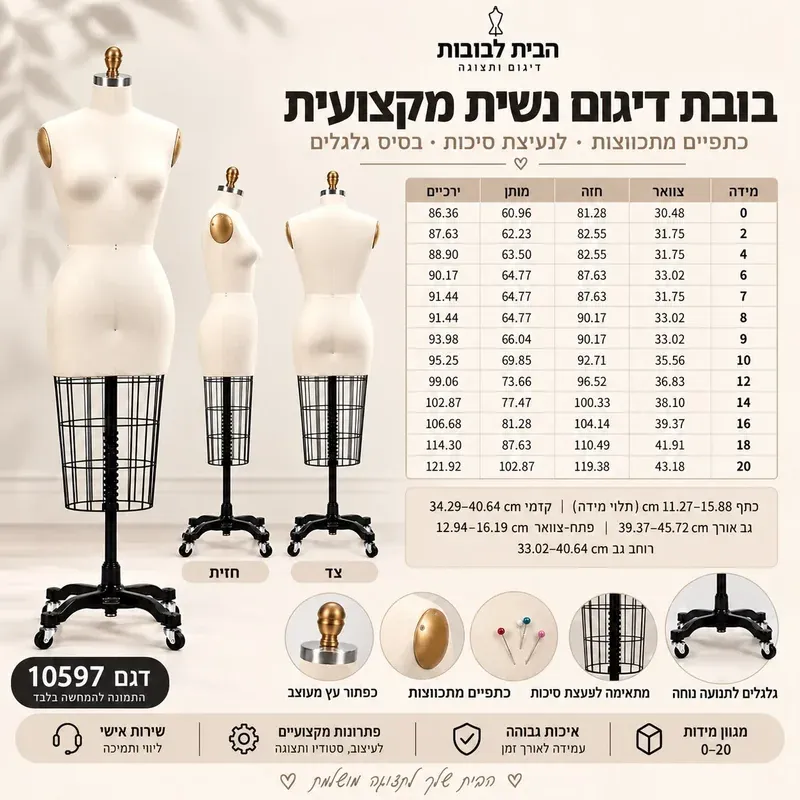
Also called a standard-size form. Its measurements were built according to a size chart and don't change. A pattern built on it comes out identical every time, which makes it the form for studios, design schools and anyone developing a collection. Professional forms also have reference lines sewn onto the cover: center front and back, side seams and waistline.
The professional dress form with collapsible shoulders and cage series comes in 13 sizes, from 0 to 20, with a full measurement chart for each size.
Adjustable Dress Form
Also called an expandable or variable-size form. The body is made of several sections, and dials let you widen or narrow the bust, waist and hips. It suits a dressmaker who works with clients of different sizes, and home sewing for several family members.
It has two limitations worth knowing in advance. When you expand it, gaps open up between the sections, and in those areas it's hard to pin precisely. And its measurements are a range, so it doesn't replace a fixed-size form when you need an accurate base pattern. The PRYM Prymadonna dress form, for example, is made of 8 sections with 13 adjustment points and a hem marker, and in size L it covers a bust of 112 to 127 cm.
Dress Form with Hips
A form whose body continues below the waistline, down to the hips or mid-thigh. It's needed for anything that sits on the pelvis: pants, fitted skirts, bodycon dresses and swimwear. A form that ends at the waistline won't show how the garment falls over the hips.
On the site you'll find a dress form with hips on an adjustable stand in six sizes, and an anatomical form down to mid-thigh, which is especially suited to swimwear and bodysuits.
Quick Comparison of the Types
Fixed-size: for studios, fashion schools, production and couture. The same pattern every time and pinning at any point. The limitation: one size per form.
Adjustable: for a dressmaker with clients of different sizes and for home sewing. One form for several sizes. The limitation: gaps between sections and lower accuracy.
With hips: for pants, skirts, bodycon dresses and swimwear. You see how it falls over the pelvis. The limitation: takes up more space.
How to Choose a Dress Form Size
Choose by measurements in centimeters, not by the number on the label. A US size 8, a European size 38 and a size M don't describe the same body at every manufacturer. The measurements do.
Here's how to measure, with a flexible tape measure that doesn't stretch:
Bust: around the fullest point of the bust, with the tape level to the floor across the back as well.
Waist: at the narrowest point of the body, usually a few centimeters above the navel.
Hips: around the widest part of the seat.
Compare the three numbers with the form's size chart. When your measurements fall between two sizes, choose the smaller one. You can add padding to the form where needed, but you can't make it smaller.
If you're developing a collection, the question is different: you choose the base size on which you build the first pattern. Grading to the other sizes is done later, on paper.
The Details That Make a Difference in Everyday Work
A Cover That Takes Pins
A padded body, usually a polystyrene or firm foam core, covered in fabric. The pin should go in easily and hold without falling out. Pin at a sharp angle to the body rather than perpendicular, so the pin holds better and leaves fewer marks.
Collapsible Shoulders
Plates in the shoulders that press inward. You collapse the shoulder, slip the garment over the body and release it. Without this, you can't dress the form in a tailored jacket or a dress with a narrow neckline without stretching the seams.
Cage Below the Hips
A frame of metal rods that continues the body line. It lets you see how a skirt or dress falls all the way to the hem, and mark the length from every side.
Stand and Casters
A height-adjustable pole lets you work standing up without bending over, and set the waistline at eye level while marking. A base with casters saves lifting the form every time you move between the cutting table and the ironing station. A wooden tripod base, like the one on the sewing form on a wooden stand, is more stable and quieter, and suits a permanent workspace.
Dress Forms for Men and Children
Men's suits, jackets and pants need a body with male proportions: wider shoulders, a flat chest and a lower waist. A large women's form doesn't replace it. You'll find the options in Men's Dress Forms. For children's clothing, choose by age and height, in Children's Dress Forms.
Is It Worth Buying a Secondhand Dress Form?
It can be, provided you check a few things before buying. Ask for the size chart or measure the form yourself. Check that the cover is intact and not torn around the shoulders and waist, where you work the most. On an adjustable form, turn every dial and make sure it moves and locks. And check that the pole doesn't wobble at full height. A form with a damaged cover or a stuck mechanism ends up costing more than a new one.
Common Mistakes When Choosing
Choosing a size by the label: only the measurements in centimeters count.
Buying an adjustable form for a studio: work on base patterns and collections needs a fixed size.
Skipping hips when you sew pants and skirts: without a pelvis, you can't see the drape.
Ironing directly on the cover: use steam only and keep the iron away from the fabric, so you don't scorch or shrink it.
Leaving the form uncovered: a light-colored cover collects dust. When the form isn't in use, cover it with a fabric cover.
Forms for Studios, Schools and Wholesale
When equipping with several forms, decide on the size distribution in advance according to the class or production line, rather than buying everything in one size. We're direct importers, and for bulk orders we tailor the size distribution to your needs. You can come see the forms at our showroom in Tel Aviv, or contact us for advice and a wholesale quote.
Frequently asked questions
What is the difference between a dress form and a sewing form?
There is no difference. These are two names for the same product: a body padded and covered with fabric that you can stick pins into. The term mannequin is also sometimes used, but it also includes display mannequins.
Which dress form suits a beginner?
For someone sewing for herself, a fixed-size form close to her measurements, or an adjustable form whose range covers her circumferences. If you plan to continue to design studies, it's better to start right away with a fixed size.
Can I stick pins into any dress form?
In a form that is padded and covered with fabric, yes. In an adjustable form, it is hard to pin in the area of the gaps between the parts. You cannot pin at all into a fiberglass or plastic display mannequin.
What do I do when my measurements fall between two sizes?
Choose the smaller size and add padding in the areas that need it. The form cannot be made smaller.
Do I need a form with hips?
If you sew pants, fitted skirts, bodycon dresses or swimwear, yes. For shirts, jackets and dresses that are full from the waist, a form that ends at the waistline is enough, preferably with a cage.
How much does a dress form cost?
The price depends on the type of form and the stand. A professional fixed-size form, with collapsible shoulders, a cage and a caster base, costs more than a simple form on a stand, because it is built for daily work over years. The price of each model appears on the product page, and for orders of several forms we give a wholesale quote.
What is a dress form called in English?
Dress form, and in Britain also Dressmaker's dummy. An adjustable form is called an Adjustable dress form. The term Mannequin is used mainly for a display mannequin, and it's worth paying attention to this when searching on sites abroad.
What is a dress form with a cage?
This is a form that has a cage of metal rods below the hip line, which looks like a net. The cage continues the body line down to the hem, and lets you see how a skirt or a dress falls and mark the length from all sides.
Do I need a dress form with legs?
Only for regular work on long, fitted trousers. For most work on trousers, skirts and swimwear, a form with hips down to mid-thigh is enough, which takes up less space and is easier to dress.
Why do I need a dress form with arms?
For sewing jackets, coats and dresses with sleeves. An arm that attaches to the shoulder lets you check how the sleeve hangs and its length on the form, without waiting for a client fitting. When you do not need it, you take it off.
Dress form or display mannequin for a store?
For display in a store, use a display mannequin. A fabric-covered dress form suits a boutique or a bridal salon that wants a studio look. You can find the differences between types of display mannequins in the guide to choosing display mannequins.