הבית לבובות דיגום ותצוגה
Women's Full-Body Dress Form with Arms and Legs, Neck-Hung on a Rolling Stand – 13 Sizes
Specify the size (0 to 20, including 7 and 9) in the order notes
In stock
SKU: 2380
Product description
Full-body dress form: a complete look on one work tool
A regular dress form ends at the hip line. Here the body continues: full arms, separate legs and a shaped crotch area, so you can build and test on the form trousers, overalls, bodysuits, leggings and long evening dresses too. In the fashion world it is called a full body form, and it is the standard tool in a studio that works on a complete look and not just on the upper part.
The body is covered in cream-colored fabric, with a feminine shape with bust, waist and hip curves. The arms hang down along the body, so you can dress it in jackets and dresses with sleeves and see how the sleeve falls.
Hung from the neck: the legs stay free
A form with legs cannot have a central pole like a torso form, because the pole would pass exactly through the area where you work on the crotch and the trouser line. That is why the form is hung from the neck on a fixed metal arm that extends from a side pole. The crotch, hips and lower legs are completely free, and you can dress it in trousers, mark the inseam and check the fall around the leg from every side.
The stand rests on a base with four wheels, so you move the form between the cutting table, the mirror and the photo area without lifting it.
13 sizes with a full chart
The form comes in one fixed size, to be chosen from 13: sizes 0 to 20 in the American system, including 7 and 9. Each size has nine measurements: neck, bust, waist and hip circumference, front length and back length, and also upper thigh, knee and calf circumference, without which it is hard to drape accurate trousers. The chart shows that in sizes 7 and 9 the front and back lengths are shorter than in the neighboring sizes 6 and 8, so choose by the numbers and not by the order of the sizes. The full chart appears in the technical specifications.
Common uses
- Draping and fitting patterns for trousers, jeans, overalls and leggings.
- Draping work on long evening and wedding dresses, including checking the fall along the leg.
- Bodysuits, swimwear and sportswear that pass through the crotch.
- Dressing a complete look for a catalog shoot or a studio display.
- Teaching and demonstration in class, when you want to show the relationship between the upper and lower pattern.
Who it is for
- Fashion designers who work on full collections.
- Fit models and pattern makers in fashion houses and manufacturing plants.
- Fashion design schools and fashion programs.
- Workshops for evening and wedding dresses that check length and fall down to the leg.
- Fashion photography studios.
Professional tips
- Choose the size by the measurement that is critical for the garment: for trousers, hip and upper thigh circumference; for a fitted dress, bust and waist.
- In sizes 7 and 9, check the front and back lengths against the pattern, since they suit a shorter upper body.
- Before working on trousers, mark the waistline and the hip line on the form with thin marking tape, so you can return to the same points in every measurement.
- When moving the form on its wheels, hold the stand's pole and not the form itself, so as not to load the hanging point at the neck.
- For long dresses, work with the stand on a level surface, so the hemline is measured correctly.
- Cover the form with a fabric cover when not in use, to keep the covering free of dust.
Common mistakes
- Choosing by size number alone: American sizes do not map one to one onto Israeli or European sizes. Compare the measurements in centimeters with your client's measurements or with your collection's size chart.
- Assuming size 7 is larger than size 6 in every measurement: in the chart, the neck circumference, waist circumference and lengths in size 7 are smaller than those of size 6. Size 9 is also smaller than size 8 in some measurements.
- Draping trousers on a torso form: without legs you cannot check the crotch, inseam and fall around the thigh. That is exactly the role of a full-body form.
How it differs from the dress form on an adjustable stand
The site also has a women's dress form for pinning on an adjustable stand with wheels, also in 13 fixed sizes. That is an upper-body form: it ends at the hip line, stands on a central pole and suits blouses, jackets, dresses and skirts. The form on this page is a full body with arms and legs, hung from the neck, and is chosen when you also need to work on trousers, bodysuits and full-length dresses. All the dress forms are in the dress forms and sewing category.
Images are for illustration only; slight differences in shade may occur between different screens.
Specifications
Type: women's full-body dress form, with arms and legs
Covering: cream-colored fabric
Hanging: from the neck, on a fixed metal arm on a side pole
Base: black, with 4 wheels
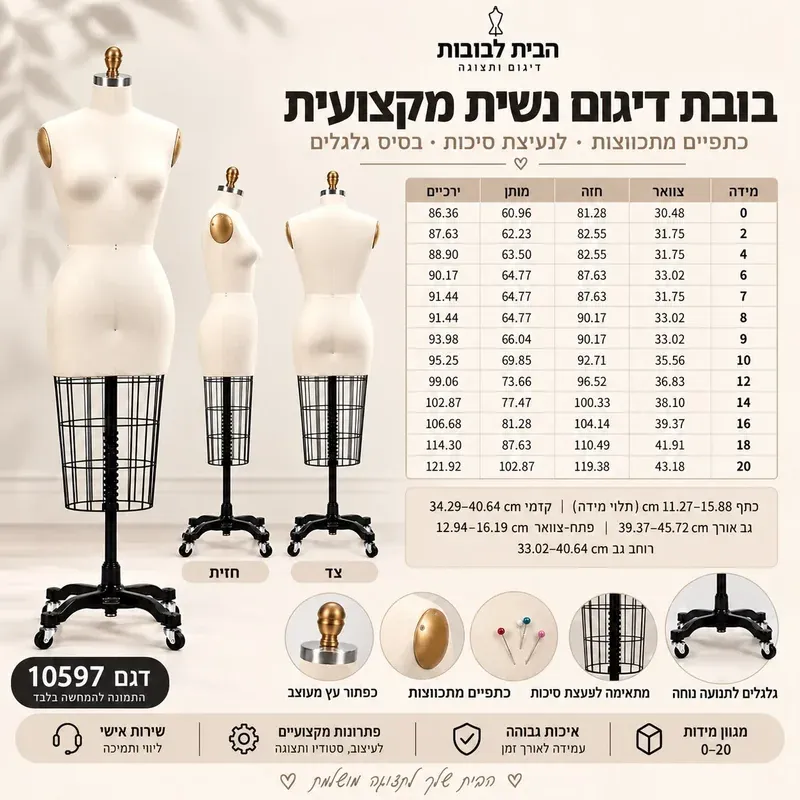
Sizes to choose from: 0, 2, 4, 6, 7, 8, 9, 10, 12, 14, 16, 18, 20 (American system)
Chart units: all measurements in centimeters, in this order: neck circumference | bust circumference | waist circumference | hip circumference | front length | back length | upper thigh circumference | knee circumference | calf circumference
Size 0: neck 30.5 | bust 81.3 | waist 61 | hips 86.4 | front length 34.3 | back length 39.4 | upper thigh 47.6 | knee 31.8 | calf 26.7 (cm)
Size 2: neck 31.8 | bust 82.6 | waist 62.2 | hips 87.6 | front length 34.9 | back length 40 | upper thigh 48.3 | knee 32.4 | calf 27.3 (cm)
Size 4: neck 31.8 | bust 85.1 | waist 63.5 | hips 88.9 | front length 35.6 | back length 40.6 | upper thigh 49.5 | knee 33 | calf 29.2 (cm)
Size 6: neck 33 | bust 87.6 | waist 64.8 | hips 90.2 | front length 36.2 | back length 41.9 | upper thigh 50.8 | knee 33.7 | calf 31.1 (cm)
Size 7: neck 31.8 | bust 87.6 | waist 63.5 | hips 91.4 | front length 34.9 | back length 40 | upper thigh 51.1 | knee 33 | calf 30.5 (cm)
Size 8: neck 34.3 | bust 90.2 | waist 67.3 | hips 92.7 | front length 36.8 | back length 41.9 | upper thigh 52.7 | knee 34.6 | calf 32.1 (cm)
Size 9: neck 33 | bust 90.2 | waist 66 | hips 94 | front length 35.6 | back length 40.6 | upper thigh 52.7 | knee 34.3 | calf 31.8 (cm)
Size 10: neck 35.6 | bust 92.7 | waist 69.9 | hips 95.3 | front length 37.5 | back length 42.5 | upper thigh 54.6 | knee 35.6 | calf 33 (cm)
Size 12: neck 36.8 | bust 96.5 | waist 73.7 | hips 99.1 | front length 38.1 | back length 43.2 | upper thigh 57.2 | knee 36.8 | calf 34.3 (cm)
Size 14: neck 38.1 | bust 100.3 | waist 77.5 | hips 102.9 | front length 38.7 | back length 43.8 | upper thigh 59.7 | knee 38.1 | calf 35.6 (cm)
Size 16: neck 39.4 | bust 104.1 | waist 81.3 | hips 106.7 | front length 39.4 | back length 44.5 | upper thigh 62.2 | knee 39.4 | calf 36.8 (cm)
Size 18: neck 41.9 | bust 110.5 | waist 87.6 | hips 114.3 | front length 40 | back length 45.1 | upper thigh 68.6 | knee 48.3 | calf 45.7 (cm)
Size 20: neck 43.2 | bust 119.4 | waist 102.9 | hips 121.9 | front length 40.9 | back length 45.7 | upper thigh 73.7 | knee 49.5 | calf 47 (cm)
SKU: 2380
Unit of sale: per unit – one form in the size of your choice
Frequently asked questionsFrequently asked questions
What sizes are available for the full-body dress form?
13 sizes in the American system: 0, 2, 4, 6, 7, 8, 9, 10, 12, 14, 16, 18 and 20. Each form comes in one fixed size.
What are the circumferences of the chest, waist and thighs?
The chest circumference ranges from 81.3 cm in size 0 to 119.4 cm in size 20, the waist between 61 and 102.9 cm and the hips between 86.4 and 121.9 cm.
What dimensions of the leg appear in the table?
Upper thigh circumference, knee circumference, and calf circumference. Size 10, for example: upper thigh 54.6 cm, knee 35.6 cm, and calf 33 cm.
Why does the form hang from the neck instead of standing on a pole?
Because the form has legs, and a central pole would block the crotch area. Hanging from the neck leaves the legs free for working on trousers from every direction.
What is the difference between size 7 and size 6?
In size 7, the neck circumference, waist circumference, and front and back length are smaller than those of size 6, and the circumference of the thighs is slightly larger. It is suitable for a body with a shorter upper body.
How do you move the form around the studio?
The stand sits on a base with four wheels, so you roll it between work areas without lifting the form. Hold the stand's pole, not the form.
What is a full-body dress form used for?
For sampling pants, overalls, bodysuits and swimwear, and for working on evening dresses and full-length. It allows you to check the garment from neck to leg.
How is it different from a regular dress form?
A regular dress form ends at the hip line and stands on a central pole. The full-body form includes arms and legs and hangs from the neck, so it is also suitable for fitting trousers.
How do I order a certain size?
Add the form to your order and state the size you want, from 0 to 20, in the order notes.
Can I order several dress forms for a school or studio?
Yes. We sell in retail and wholesale, and to order several units or several sizes together, you can contact us.