הבית לבובות דיגום ותצוגה
Professional Women's Dress Form with Collapsible Shoulders and Cage – Sizes 0–20
In stock
SKU: 10597
Product description
Professional fixed-size dress form – a work tool for the studio and the designer
A fixed-size dress form is built to an exact size chart. Unlike an adjustable form with adjustment wheels, its bust, waist and hip circumferences don't change, so a pattern built on it comes out identical every time. That's why in a studio, a fashion school and a production line, people usually work with fixed-size forms.
The body is padded and covered with fabric in a cream tone, so you can stick pins straight into the form, even at an angle, and fix fabric, a template or a garment being repaired onto it. The body lines are marked with stitching on the cover: center front and center back lines, side lines and a waistline. These are the reference points by which you transfer pattern lines and check that the garment hangs straight.
Collapsible shoulders
In the shoulders there are plates that press inward. When dressing a fitted dress, a tailored jacket or a garment with a narrow neck opening, you collapse the shoulder, pass the garment over the body and release it back. This way the garment doesn't stretch and the seams don't tear while dressing. On a form with rigid shoulders you can't dress some of these garments without first unpicking them.
A metal cage below the hips
Instead of a leg or full body, below the hip line there is a cage of metal rods. The cage continues the line of the body and lets you see how a skirt or dress falls to the hem. You can mark the length and fix the hem from every side without the fabric folding beneath the form.
Stand and base
The form is mounted on a black metal pole with height adjustment, and on a wide base with wheels. You can move it between the cutting table, the ironing station and the display window without lifting it. At the head of the form there is a shaped wooden top knob, which also serves as a grip while adjusting and moving.
Common uses
Draping – building a pattern directly on the body from raw cotton fabric, without a ready-made template
Fittings and alterations – shortening, taking in and marking hems on a worn garment, without calling the client for every fitting
Couture sewing and evening dresses – checking the drape of heavy fabrics, layers and waist belts
Production samples – checking a base pattern in a particular size before grading to the other sizes
Fashion design studies – working to standard measurements that match the pattern charts taught in school
Photography and garment display – displaying an item on a body in natural proportions in a studio or store
Who the form is for
Designers and professional seamstresses who work on custom orders and wedding and evening dresses, and need a stable body they can stick pins into for hours.
Design studios and fashion schools that equip themselves with several forms in the same size or in a series of sizes. In a quantity or wholesale order, the size distribution is matched in advance to the needs of the class or the production line.
Garment manufacturers and development departments that check samples in the base size of the collection before production.
Home seamstresses and course graduates who want to move from an adjustable form to an industrial-level form.
Professional tips for choosing and working
Choose a size by circumferences in centimeters, not by the number on the label. Measure bust, waist and hips and compare to the chart. If the measurements fall between two sizes, choose the smaller. It's easy to add padding to a form, but you can't make it smaller
For working on base patterns and for a collection, choose the size in which you start developing the pattern. Grading to the other sizes is done afterward on paper
Insert pins at a sharp angle to the body and not perpendicular. This way they hold better and leave fewer marks in the cover
Before ironing a garment that's on the form, keep the iron away from the cover and work with steam only, so as not to scorch or shrink the fabric
When the form is not in use, cover it with a fabric cover or a cover bag, so the light-colored cover doesn't collect dust
Common mistakes
Buying a display mannequin instead of a dress form – a display mannequin is usually made of fiberglass or plastic and you can't stick pins into it. For sewing work you need a padded body covered in fabric
Choosing a size by the size number in clothing stores – size numbers vary between brands. Only the circumferences in centimeters decide
Forcing a fitted garment onto the shoulders – on this form you collapse the shoulder first and only then dress. Pulling by force stretches the seams
Marking a hem without the cage – on a form that ends at the hip line it's hard to see the real drape of a skirt. The cage solves this
Torn between sizes or need several forms for a studio? You're welcome to go through the guide to choosing a dress form, see all the Dress forms for sewing, or contact us for advice and a wholesale quote. For displaying garments in a shop window there is also a selection of Display Mannequins.
Images are for illustration only; slight color differences may occur between different screens.
Specifications
Product type: professional fixed-size female dress form
Model number: 10597
Brand: HaBayit LaBubot
Cover: fabric in cream tone, padded, suitable for pinning
Shoulders: collapsible
Lower part: black metal rod cage
Stand: black metal pole with height adjustment
Base: metal base with wheels
Top knob: shaped wood
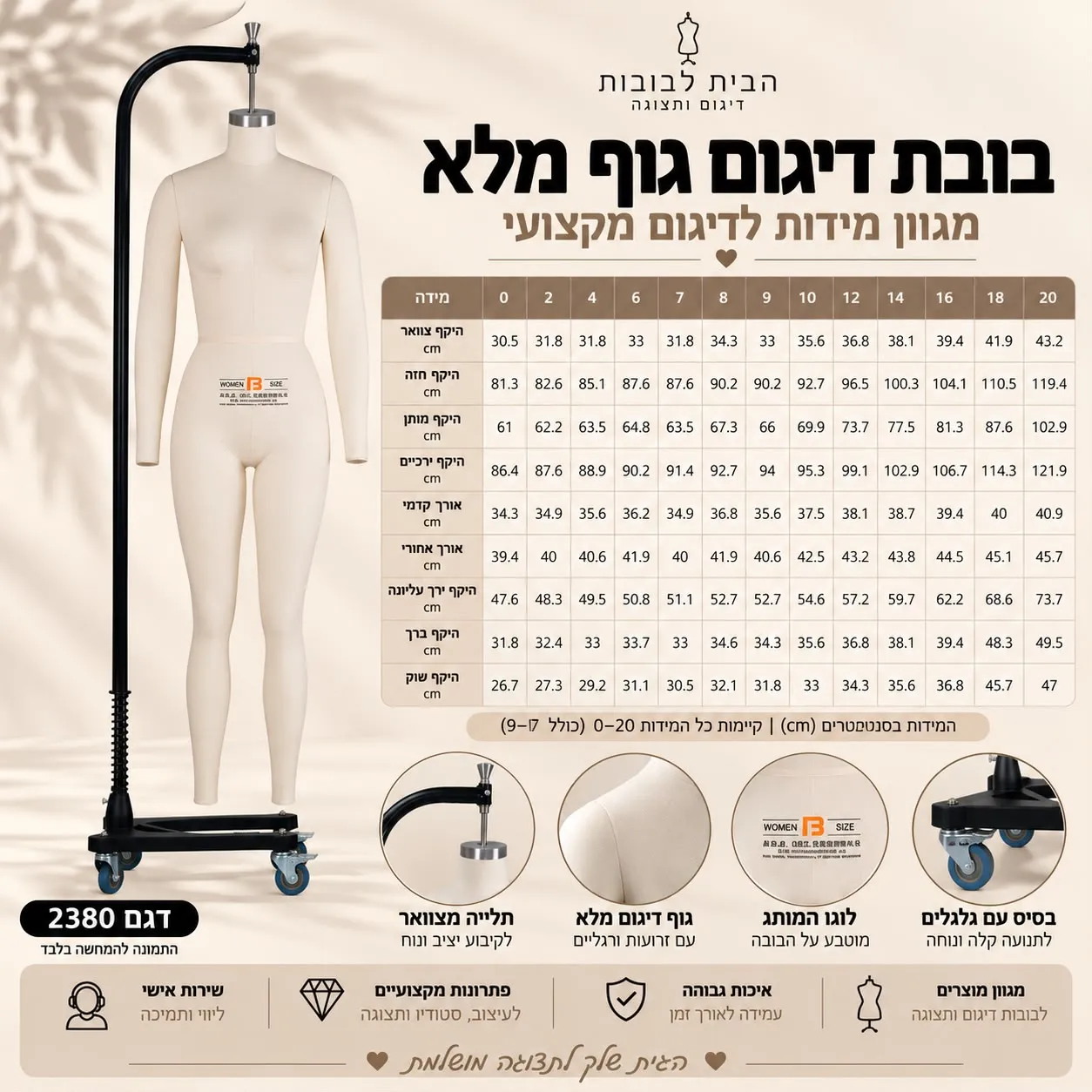
Size range: 0 to 20 (13 sizes)
Size 0: neck 30.48 cm, bust 81.28 cm, waist 60.96 cm, hips 86.36 cm
Size 2: neck 31.75 cm, bust 82.55 cm, waist 62.23 cm, hips 87.63 cm
Size 4: neck 31.75 cm, bust 82.55 cm, waist 63.50 cm, hips 88.90 cm
Size 6: neck 33.02 cm, bust 87.63 cm, waist 64.77 cm, hips 90.17 cm
Size 7: neck 31.75 cm, bust 87.63 cm, waist 64.77 cm, hips 91.44 cm
Size 8: neck 33.02 cm, bust 90.17 cm, waist 64.77 cm, hips 91.44 cm
Size 9: neck 33.02 cm, bust 90.17 cm, waist 66.04 cm, hips 93.98 cm
Size 10: neck 35.56 cm, bust 92.71 cm, waist 69.85 cm, hips 95.25 cm
Size 12: neck 36.83 cm, bust 96.52 cm, waist 73.66 cm, hips 99.06 cm
Size 14: neck 38.10 cm, bust 100.33 cm, waist 77.47 cm, hips 102.87 cm
Size 16: neck 39.37 cm, bust 104.14 cm, waist 81.28 cm, hips 106.68 cm
Size 18: neck 41.91 cm, bust 110.49 cm, waist 87.63 cm, hips 114.30 cm
Size 20: neck 43.18 cm, bust 119.38 cm, waist 102.87 cm, hips 121.92 cm
Shoulder length: 11.27–15.88 cm (by size)
Front length: 34.29–40.64 cm (by size)
Back length: 39.37–45.72 cm (by size)
Neck opening: 12.94–16.19 cm (by size)
Back width: 33.02–40.64 cm (by size)
Sales unit: per piece
Frequently asked questions
Frequently asked questions
What are the circumferences of the dress form in each size?
The circumferences range from bust 81.28 cm, waist 60.96 cm and hips 86.36 cm in size 0, up to bust 119.38 cm, waist 102.87 cm and hips 121.92 cm in size 20. The sizes are available in 13 sizes: 0, 2, 4, 6, 7, 8, 9, 10, 12, 14, 16, 18 and 20. The full chart, including neck circumference, appears in the technical specifications.
What is the function of the collapsible shoulders?
The collapsible shoulders let you put a fitted garment or a garment with a narrow neckline on the form without stretching it. You press the shoulder plate inward, pass the garment over the body and release. This way the seams aren't stretched and the fabric isn't damaged, which is especially important when working on evening gowns, tailored jackets and garments made of non-stretch fabrics.
Can I stick pins into the form?
Yes. The body is padded and covered with fabric, and you can stick pins straight into the form to secure fabric, a pattern or a garment being altered. It is recommended to insert the pin at a sharp angle to the body and not perpendicular, so it holds better and leaves fewer marks in the covering.
How do I choose the right dress form size?
Choose by circumferences in centimeters and not by the size number. Measure bust, waist and hips, of the client or of the base size in the collection, and compare with the size chart. If the measurements fall between two sizes, choose the smaller one, because it is easy to add padding to a form but you cannot make it smaller.
What is the difference between a fixed-size dress form and an adjustable form?
In a fixed-size dress form the circumferences are fixed and exact according to a size chart, so a pattern built on it comes out identical every time. This is the standard choice in a studio, a fashion school and production. In an adjustable form you change the circumferences with adjustment dials; it suits home sewing for the sizes of several people, and it usually has gaps between the parts that make exact pinning harder.
Why does the form have a cage at the bottom?
The cage replaces the hips and legs with an open, light structure. It keeps the shape of the body at the waistline, and lets you hang a skirt or long dress without the fabric touching the post.
How do you build a pattern on a dress form using the draping method?
Place plain cotton fabric on the form, secure it with pins along the body lines and mark the seam lines and darts on it. Then take the fabric off and transfer the markings to pattern paper.
What do I do when a client's measurements fall between two sizes?
Choose the smaller size and add padding in the wider areas. A dress form can be enlarged with padding, but it cannot be made smaller.
Is it worth buying several sizes for a studio?
In a studio that works on size grading or on several clients at once, two or three sizes save repeated padding. Start with the size that is common among your clients and add as needed.
How do you adjust the form's height?
The post is height-adjustable. Set it so that the form's shoulder line is at the height of the client's shoulders, or at a comfortable height for working seated when marking hems.