Women's dress forms
Women's dress forms for sewing, cutting and fitting garments: fixed-size forms by bust measurement, adjustable forms with adjustment dials, and forms with hips on an adjustable pole. Every form in this category is pinnable and suits dressmakers, fashion designers, students and studios. Retail and wholesale, personal help choosing your size, and delivery across Israel.
Products: 5


Women's Dress Form: A Constant Fitting Model Instead of Repeated Fittings
A dress form is an anatomical female body on which you measure, pin, cut and fit a garment before final sewing. Unlike a display mannequin, which is designed to show a finished garment in the shop window, a dress form is built for work: the body is covered in fabric or a foam layer, takes pins across its entire surface and keeps accurate proportions of bust, waist, hips and shoulders. For in-store display mannequins, visit women's display mannequins.
Types of Women's Dress Forms
Fixed-Size Dress Form
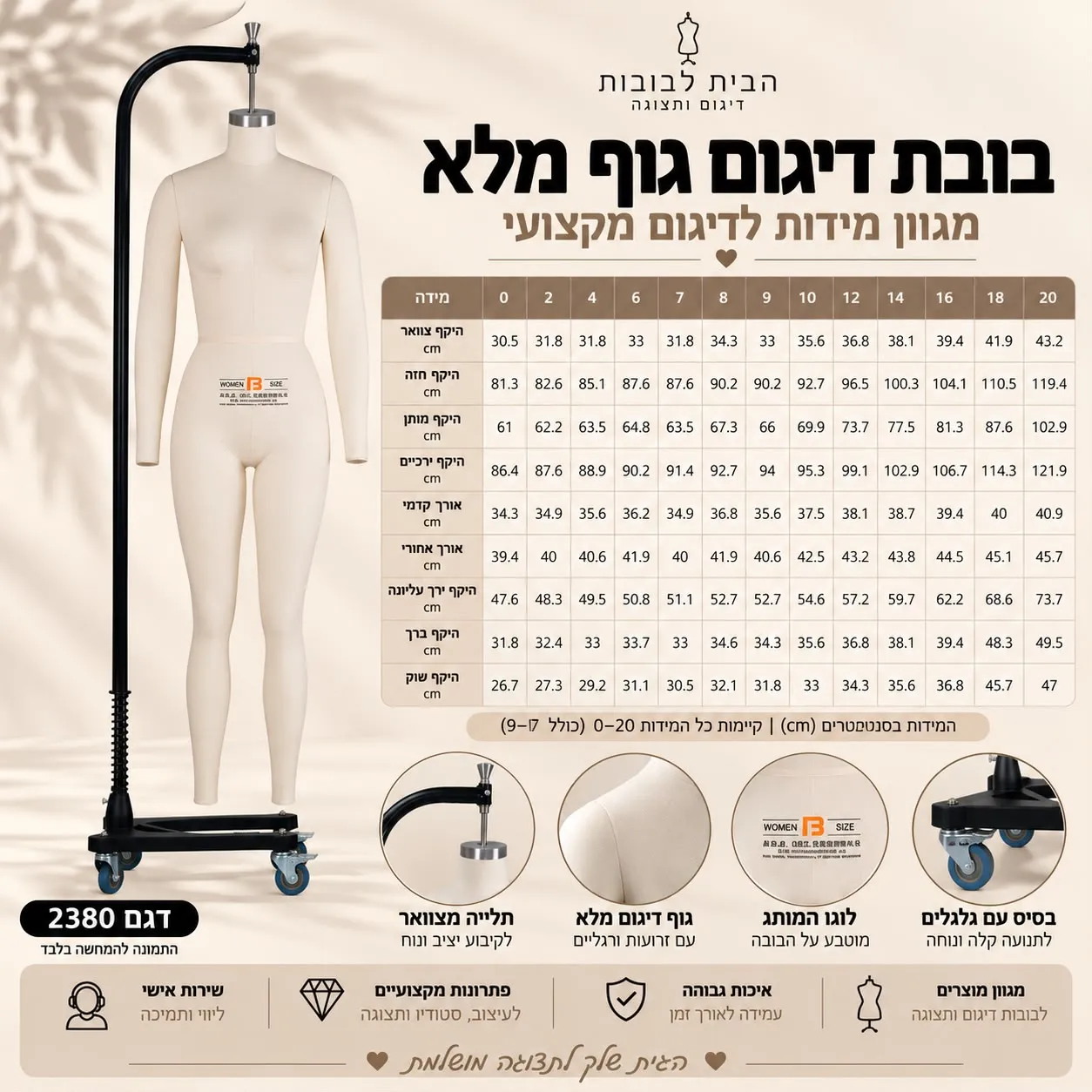
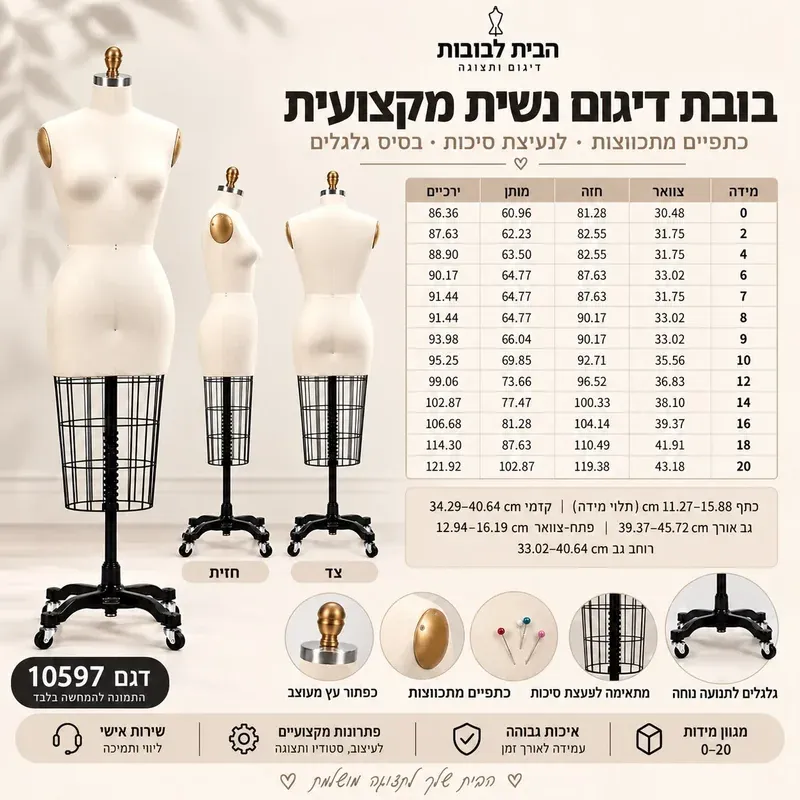
The body is rigid and continuous, with no gaps between parts, so it is stable and accurate for one size. The size is determined by the bust circumference in cm, and each size comes with matching shoulder width, waist circumference and hip circumference. This is the standard choice in studios and production lines that work on one base size and grade sizes from there.
Adjustable Dress Form
The body is divided into sections that open and close with adjustment dials. The PRYM Prymadonna form, for example, has 8 sections and 13 adjustment points for the neck, bust, waist, hips and back length, and a hem marker comes with the form. One form covers a whole range of sizes, so it suits those who sew for several women, those whose measurements change, and sewing classes. Good to know: when the form is opened to its maximum size, gaps form between the sections and the surface is less continuous than on a fixed form.
Dress Form with Hips
A body that continues below the waistline down to the hips. It is especially convenient for working on skirts, fitted dresses and low waistlines. Most dress forms end at the hip line, so they are suitable for dresses, skirts, blouses, jackets and coats, but not for fitting trousers.
How to Choose the Size of a Women's Dress Form
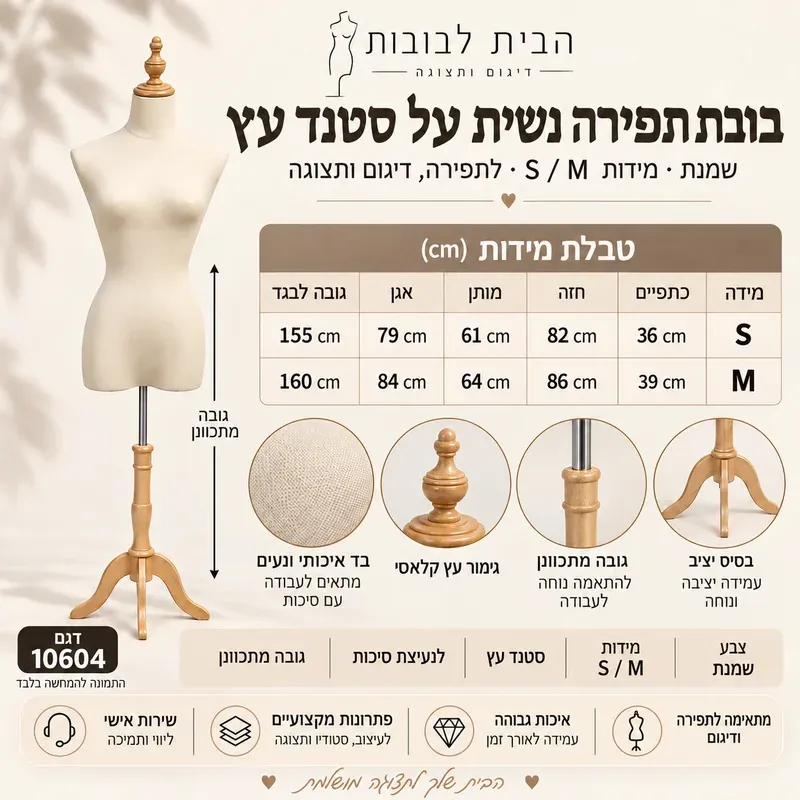
Measure the bust, waist, hips and shoulder width with a tape measure, and compare with the size chart on the product page. An approximate conversion chart based on the common European system:
Bust 80 cm: approximately size 34
Bust 84 cm: approximately size 36
Bust 88 cm: approximately size 38
Bust 92 cm: approximately size 40
Bust 96–100 cm: approximately sizes 42–44
Bust 112–127 cm: sizes 48–54, a range covered by an adjustable form in size L
The professional rule: if your measurements fall between two sizes, choose the smaller form and pad it with layers of batting where needed. You can always add volume to a form, but you cannot make it smaller. For a full comparison of the types, read our guide to choosing a dress form.
What to Check Before Buying
Pinning: a fabric-covered polystyrene core, or foam with a nylon cover. Pin at a sharp angle: the pin holds better and leaves a smaller mark on the body.
Base and pole: a wooden tripod for a home sewing corner, a four-leg base for adjustable forms, or a five-arm base with wheels that moves the form around the studio without lifting it.
Height adjustment: an adjustable pole, on some models with a range of 120 to 170 cm, lets you work at eye level and measure lengths according to the client's height.
Hem marker: marks a straight, even line along the entire hem of a dress or skirt.
Guide lines: we recommend marking a centre front line, waistline and bust line on the form with narrow tape for more accurate pattern work.
For Studios, Colleges and Stores: Wholesale Purchasing
HaBayit LaBubot is a direct importer of PRYM forms and supplies dress forms in bulk to fashion schools, sewing classes, studios and sewing workshops. For lingerie, swimwear and sports stores, the category also includes display hips in a natural skin tone. For a bulk price quote, reach us via Contact Us.
Complements for Working on the Form
Pins, pincushions and marking tools are in sewing accessories. For pressing seams and darts on a curved body, see our pressing hams. A finished garment is kept safe in a dress and suit cover. For working on men's and children's clothing there are men's dress forms and children's dress forms, and you will find every type in dress forms and sewing forms.
Shipping Nationwide
Our forms are shipped packed and protected anywhere in Israel. Details on delivery times and returns are on the Shipping and Returns page.
Related guides:
Frequently asked questions
How do I know which size of women's dress form to buy?
Measure bust, waist and hip circumference with a tape measure and compare to the size chart on the product page. Fixed-size forms are marked by bust circumference in cm: 84 cm roughly suits size 36, and 88 cm size 38. If the measurements fall between two sizes, choose the smaller form and pad with batting as needed, because you can add volume to a form but you can't make it smaller.
What is the difference between an adjustable dress form and a fixed-size dress form?
A fixed-size form is a single rigid, continuous body. It is stable and accurate for one size, and suits studios and production. An adjustable form is built of parts that expand with adjustment dials, and one form covers a whole range of sizes. For example, a PRYM form in size L covers a bust circumference of 112 to 127 cm. It suits someone sewing for several women, but when it is opened to a large size, gaps form between the parts. A full comparison between the types is in the guide to choosing a dress form.
Can I stick pins into a dress form?
Yes. All the forms in the category allow pinning, because the body is made of a foam core covered with fabric or of foam in a nylon cover. It is recommended to insert at a sharp angle and not perpendicular: the pin holds better and the mark in the body is smaller. Fiberglass or plastic display mannequins are not meant for pinning.
Can I fit pants on a women's dress form?
Most dress forms end at the hip line, so they suit dresses, skirts, blouses, jackets and coats. A form with extended hips is convenient for working on skirts and low waistlines. Fully fitting pants requires a form with legs, and you can check availability with us via Contact.
Can dress forms be bought in quantity for a studio, a college or a sewing class?
Yes. HaBayit LaBubot is a direct importer of PRYM forms and also sells wholesale to fashion schools, sewing classes, studios and stores. For a quote for quantities, contact us on WhatsApp at 055-2473993 or through the Contact page. Delivery is nationwide, and more details are on the Shipping and Returns page.
How do I pad a dress form to a client's measurements?
Attach thin layers of batting or fleece in the areas where the client is wider than the form, and put a fitted fabric cover over them. A dress form can be enlarged with padding, but it cannot be made smaller, so between two sizes choose the smaller one.
What do the sizes on women's dress forms mean?
There are two common systems. Sizes 0 to 20 are the American sizing system, and numbers such as 80 or 92 are the bust circumference in centimeters. In any case, choose by the circumference chart and not by the number.
Why do some forms have a cage at the bottom?
The cage replaces the hips and legs with an open, light structure. It keeps the shape of the body at the waistline, and lets you hang a skirt or long dress without the fabric touching the post.
What height should a dress form be set to?
Set it so that the form's shoulder line is at the height of the customer's shoulders. This way the garment length and the hem are checked as they would be on the body. For hem work, you can lower the form to a comfortable seated height.
What is draping and how do you do it on a dress form?
Draping is building a pattern directly on the form. Place plain cotton fabric on the body, secure it with pins along the body lines, and mark the seam lines and darts. Then take the fabric off and transfer the markings to pattern paper.