Pressing hams
Ironing pads on wooden bases for dressmakers, tailors, fashion designers and sewing schools: a long sleeve board and a compact sleeve board, a seam roll, a mushroom pressing pad, a universal pad on a tall stand, a pad with a slot for button plackets, and a pointed wooden pad for collar points. They are used for pressing sleeves, shoulders, puff sleeves and corners without flattening the shape you have sewn. The ironing boards subcategory has folding boards. Retail and wholesale, self-pickup in Tel Aviv and delivery nationwide.
Products: 7



Why pressing on a flat ironing board is not enough
The human body is curved, and a garment is sewn to wrap around it. A bust dart, a princess seam or a sleeve cap creates a three-dimensional shape. When you press them on a flat ironing board, the iron flattens the curve, creates creases beside the seam and undoes part of the work done on the machine. A sleeve that has already been closed into a tube also gets a fold line along its full length on a regular board.
The pressing tools in this category solve the problem differently for each part of the garment: a long, narrow surface that slides inside a sleeve, a rounded dome for areas with volume, and a thin wooden tip for corners with no room for a padded cushion. All of them stand on a wooden base or post, so the garment hangs around them rather than being pressed against the table. They are part of the sewing equipment category.
Types of pressing tools in this category
Long sleeve board: A padded board about 56 cm long on two wooden posts, 15 cm high overall, with a blue cover. Slide a whole sleeve or trouser leg onto it and press the seam open along its full length without ironing the other side of the garment.
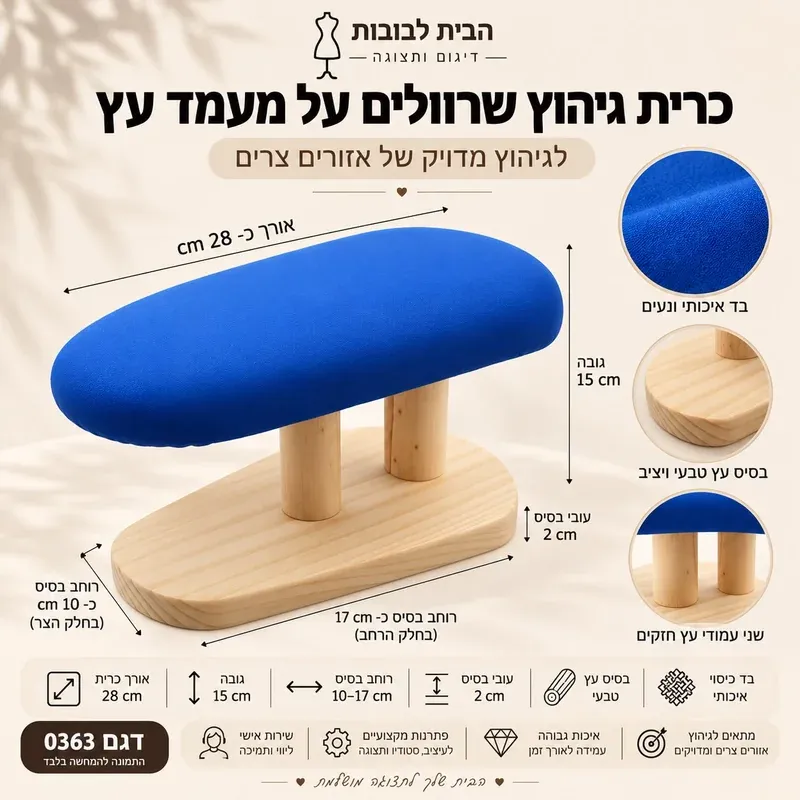
Compact sleeve board: About 28 cm long on two wooden posts, 15 cm high, with a blue cover. Suited to cuffs, short sleeves, short hems and children's clothes, and takes up little space on the sewing table.
Seam roll-style board on a wooden post: A tapered cushion 31 cm long, 22.5 cm high overall, with a white cover. The wide end suits a sleeve cap, shoulder and jacket front, while the narrow end fits into cuffs, children's sleeves and collars.
Universal cushion on a tall stand: A padded roll 21 cm long and 14 cm thick, on a 40 cm high wooden stand with a 23 × 16 cm base. One end of the roll is open, so you can slide a short sleeve or jacket shoulder onto it while the rest of the garment hangs below.
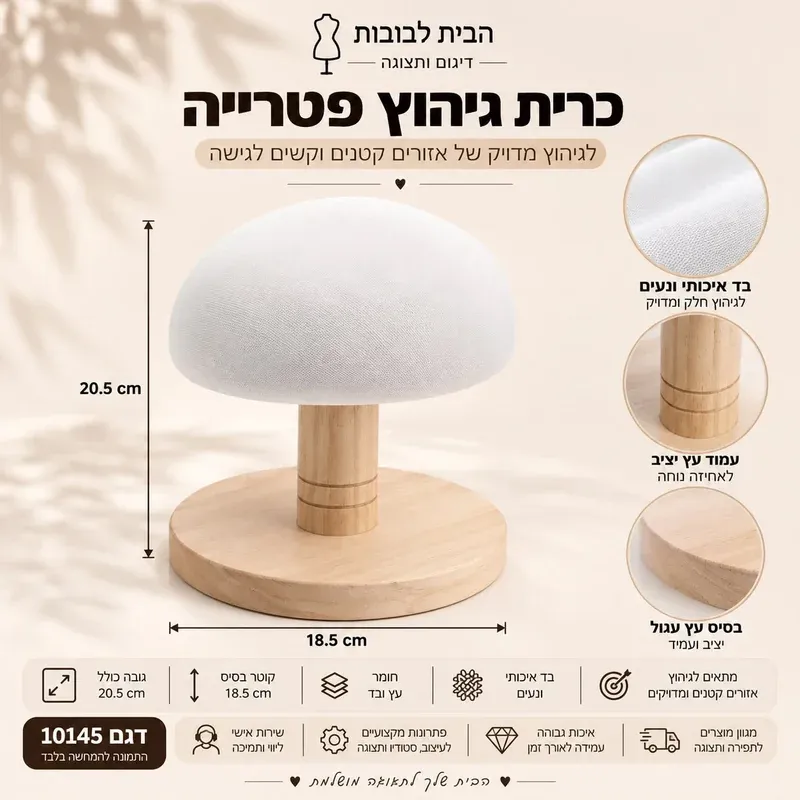
Mushroom pressing cushion: A white padded dome on a wooden post, 20.5 cm high overall, on a round base 18.5 cm in diameter. Evenly rounded on all sides, it suits dart tips, sleeve caps, corset cups and fabric hat crowns.
Cushion with a slot: A padded surface 14 cm wide on a 33 cm long wooden base, with a U-shaped opening at the end. Buttons, zipper teeth or embellishments drop into the opening, and the surrounding fabric stays flat and pressed without marks.
Wooden point presser: Solid wood with no padding, a 19 cm top surface and 7 cm overall height. Slip a collar, lapel or cuff onto it before turning and press the seam allowances open right to the corner. A rigid wooden surface does not sink under the iron, so the corner comes out sharper and flatter.
Which pressing tool for which part of the garment
Long sleeves and trouser legs: the long sleeve board.
Cuffs, short sleeves and children's clothes: the compact sleeve board or the narrow end of the tapered cushion.
Sleeve cap and shoulder line: the universal cushion on the tall stand or the wide end of the tapered cushion.
Darts, princess seams, cups and hats: the mushroom cushion.
Button plackets, zippers and embellishments: the cushion with a slot.
Collar points, lapels and belts: the wooden point presser.
How to choose a pressing tool by type of work
Home sewing: A single tapered cushion covers shoulders, sleeve caps and cuffs. If you sew dresses with darts, add a mushroom cushion; if you sew collared shirts, add the wooden point presser.
Alterations and hemming: The work centres on sleeves, hems and trouser legs, so the long sleeve board is the key tool. The cushion with a slot makes it easier to press a button placket after replacing buttons or a zipper.
Evening and bridal wear studio: A mushroom cushion for cups and darts, a universal cushion on a stand for sleeve caps and shoulders, and a cushion with a slot for embellished areas.
Sewing schools and courses: A tapered cushion at every workstation, plus a few sleeve boards, mushroom cushions and pointed wooden tools shared by the class.
Pressing cushions and ironing boards
A pressing cushion does not replace an ironing board. Fabric before cutting, large pieces and wide dresses and skirts are pressed on a long, flat surface; the cushion comes into play once the fabric has taken on a three-dimensional shape. The ironing boards subcategory has folding boards 90, 110 and 120 cm long, with a cotton cover and an iron rest. It is handy to set the cushions on a sturdy table next to the board, so you can move from the flat surface to the cushion without shifting the garment much.
The right technique: press, don't glide
Lift and lower: On a pressing cushion you don't slide the iron back and forth. Set it down, press with steam and lift. Gliding stretches the fabric and distorts the seam line.
Let the fabric cool: Fabric sets its shape as it cools. Leave the piece on the cushion until it is cool and dry, and only then move it.
Press from the wrong side: When you need to press from the right side, use a press cloth to prevent shine.
Press darts in the right direction: Vertical darts are usually pressed toward the centre, and bust darts downward. Press up to the dart tip and not beyond it.
Separate the seam allowances from the garment: On thin or dark fabrics, slip a strip of unprinted paper between the seam allowance and the fabric so no mark shows on the right side.
Press every seam before sewing a seam that crosses it: that way the garment is built correctly from the start.
Pressing cushion and dress form: working together
The shape is built on a dress form, sewn on the machine and given its final shape on the pressing cushion. After each stage, put the garment back on the form and check that the curve sits correctly. For the check to be accurate, the form must be the right size; you'll find the explanation in the guide to choosing a dress form.
Related guide: Pressing cushions for sewing: which cushion for sleeves, shoulders, collars and buttons
Pressing cushions for studios, tailors and sewing schools
Sewing schools, fashion programmes, studios and tailoring shops equip their workstations with pressing cushions. HaBayit LaBubot also sells pressing cushions wholesale to classrooms, workshops and stores, with quotes based on quantity. For details, contact us by phone at 03-9444226 or on WhatsApp at 055-2473993. Free pickup is available from Kfar Giladi 15 or HaMashbir 17 in Tel Aviv, or get delivery anywhere in Israel under the terms on the shipping and returns page.
Frequently asked questions
What is a pressing ham and why is it needed in sewing?
A pressing ham is a rounded padded surface, or a shaped wooden surface, on which you press parts of a garment that are not flat: sleeves, shoulders, darts, collars and button plackets. On a flat board these parts pick up creases and fold lines, while on a suitably shaped ham they keep the shape they were sewn into. That is why a pressing ham is a basic part of professional sewing equipment.
What is the difference between the long sleeve board and the compact sleeve board?
Both are padded pressing pads on two 15 cm wooden posts with a blue cover; the difference is the length. The long one, about 56 cm, lets you press a whole sleeve or trouser leg in one go. The compact one, about 28 cm, suits cuffs, short sleeves and children's clothes and takes up less space.
Why does the wooden pressing tool come without padding?
A hard wooden surface doesn't give under the iron, so seam allowances press open in a sharp, flat line. On a padded ham they stay rounded, and the corner comes out bulky after turning. The pointed tip reaches into the corners of collars, lapels and cuffs, where there is no room for a regular ham.
How do you press a dart or a curved seam on a pressing ham?
Lay the piece on the mushroom ham or on the wide end of the long ham, wrong side up, and rotate it until the curve matches the shape of the seam. Set the iron down with steam, press and lift without sliding, and press up to the tip of the dart, not beyond it. Leave the piece on the ham until it cools, then check it on a dress form.
How do you press a button placket without leaving marks on the fabric?
Use the pressing tool with the opening. Turn the garment inside out, lay the button placket so the buttons sit inside the U-shaped opening, and press from the wrong side. The fabric around the buttons stays flat on the surface, and the buttons don't get pressed into it.
What is the difference between a mushroom pressing cushion and a tailor's ham?
A tailor's ham is a cushion that sits on the table, and the garment is laid on top of it. The mushroom cushion is raised on a wooden post, so you can slip a sleeve or the upper part of a garment over it and turn it in any direction. Its dome is evenly rounded on all sides.
Does a pressing ham replace an ironing board?
No. Fabric before cutting, large pieces and wide dresses are pressed on a long, flat board, and the ham is used for shaped parts: sleeves, shoulders, darts and corners. In a home sewing corner, a folding board and a seam roll or sleeve ham are enough for most jobs.
Why do you need a press cloth?
A press cloth goes between the iron and the fabric and protects it from shine and scorching, especially on wool, dark fabrics and synthetics. Use it every time you press on the outer side of the garment.
What is the difference between ordinary ironing and pressing in sewing?
In ordinary ironing you slide the iron over the fabric to remove creases. In sewing you set the iron down, press and lift, to set the seam without stretching the fabric. After pressing, let the fabric cool in place, because it sets its shape as it cools.
How do you keep the light-coloured cover of the pressing ham clean?
Don't press freshly printed items or fabric that may bleed colour on the ham, and when needed place a pressing cloth between the garment and the ham. At the end of the job, wipe water drops off the wooden parts and let the ham dry before storing it in a dry place.